Running a small business often means handling several responsibilities at once. One moment you are speaking with a new prospect, the next you are following up on a quotation, checking an existing customer, or trying to remember which deal needs attention today.
When there are only a handful of leads, spreadsheets, notebooks, emails, and WhatsApp conversations may seem manageable. But as enquiries increase, information starts getting scattered. A follow-up gets forgotten. Two team members contact the same prospect. An important opportunity sits untouched for days.
This is where an easy CRM for small business can make a real difference.
Instead of making sales management more complicated, the right CRM should bring your leads, customers, follow-ups, deals, and sales activities into one organized system. SalesLyt, for example, positions its platform around managing leads, automated follow-ups, sales pipelines, AI-powered insights, analytics, quotations, invoices, payments, and team activities within a connected sales environment.
Why Small Businesses Struggle to Manage Sales
Small businesses rarely lose opportunities because they intentionally ignore prospects. More often, the problem is a lack of visibility.
Imagine receiving leads from your website, referrals, social media, calls, networking, and sales representatives. One salesperson maintains an Excel sheet. Another keeps notes on a phone. Customer conversations remain buried inside email threads.
Soon, answering a simple question becomes difficult:
Who needs a follow-up today?
That is why growing companies eventually move from scattered tools to CRM software for businesses. A CRM creates a central place where the team can see customer information, activities, opportunities, and next actions.
The objective isn't to add another piece of software to the team's workload. It is to make the existing sales process easier to control.
1. Keep Every Lead in One Place
Generating leads costs time and money. Losing them simply because nobody recorded or followed them properly is avoidable.
Good lead management software provides a structured way to capture and organize prospects. Instead of searching through emails or spreadsheets, salespeople can work from a common source of information.
A useful lead record can include contact details, company information, requirements, previous interactions, lead status, assigned salesperson, and the next action.
As the number of enquiries grows, sales lead management software becomes particularly valuable because managers can understand what is happening across the entire lead base rather than depending on individual updates.
SalesLyt's current feature set includes lead tracking alongside automated follow-ups and pipeline management, allowing these activities to remain connected.
2. Never Let an Important Follow-Up Disappear
A prospect may be interested without being ready to purchase immediately.
They might say:
“Call me next Tuesday.”
“Send the quotation first.”
“Contact me after the month-end.”
These conversations are easy to remember when you have five prospects. They become much harder when you are handling fifty.
This is where lead management software for small business becomes practical. Instead of relying on memory, the salesperson can record the next action and keep follow-ups organized.
SalesLyt highlights automation for repetitive activities such as reminders, follow-ups, email sends, and task assignments.
The benefit is simple: your sales process becomes less dependent on someone's memory.
3. Understand Exactly Where Every Deal Stands
Having a list of leads doesn't tell you which opportunities are actually progressing.
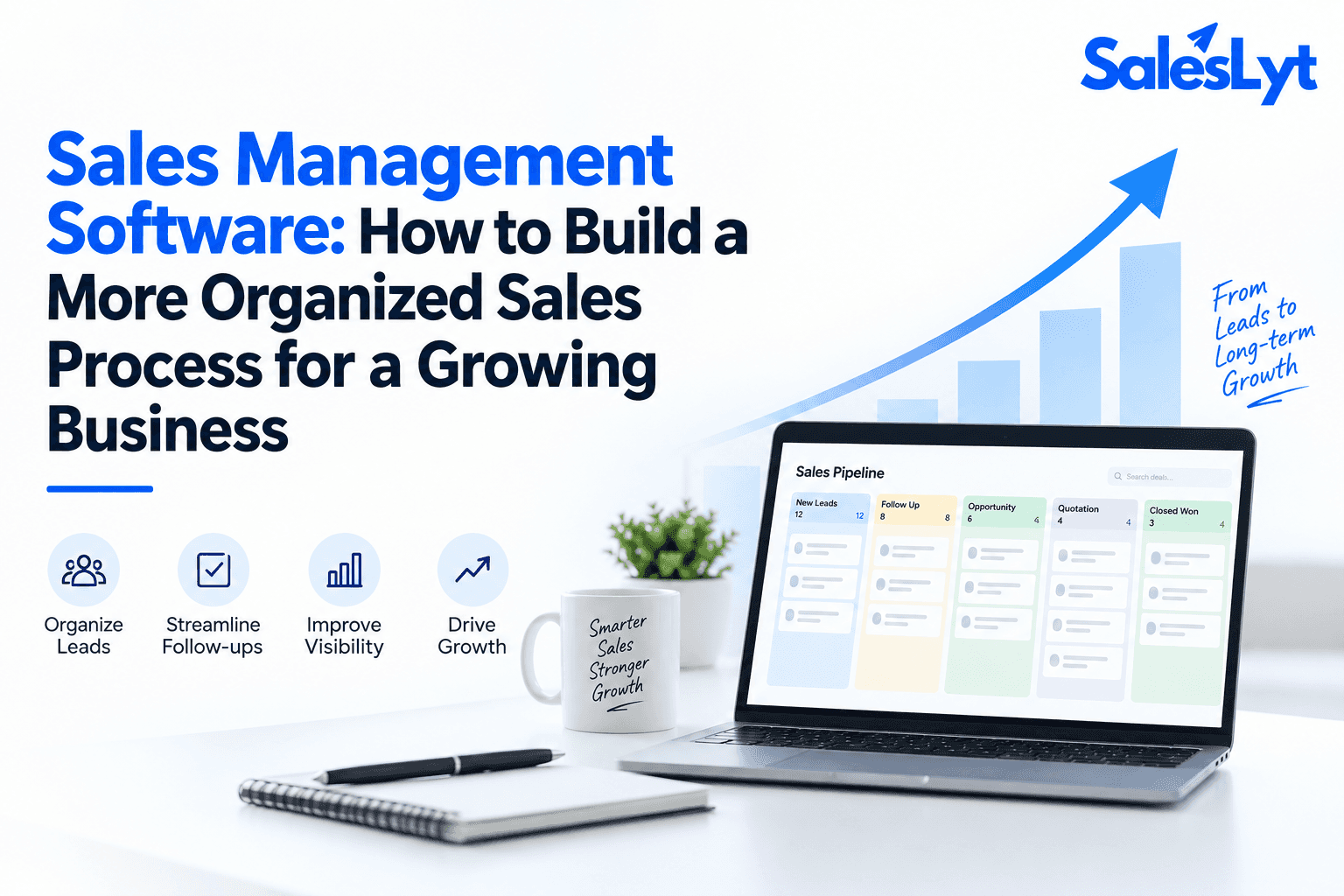
A structured sales pipeline management process divides opportunities into meaningful stages. Depending on the business, these might include New Lead, Contacted, Qualified, Proposal Sent, Negotiation, Won, and Lost.
Once deals are organized by stage, the team can quickly understand what is moving and what is stuck.
A sales pipeline tool makes this process easier to visualize, while a sales pipeline tracker helps salespeople consistently monitor opportunities and their progress.
Pipeline visibility also gives managers better questions to ask. Instead of saying, “How is sales going?”, they can investigate which proposals need attention, which deals haven't moved recently, and where opportunities are being lost.
4. Build Better Customer Relationships After the Sale
CRM isn't only about getting new leads.
Once a prospect becomes a customer, the relationship continues. Your team may need access to past conversations, quotations, invoices, payment information, activities, or future opportunities.
Keeping this information together provides context before the next customer interaction.
SalesLyt currently combines CRM capabilities with quotation and invoice management and payment tracking, which can help businesses manage more of the sales lifecycle from a connected environment.
For small businesses, that can be especially useful because teams often don't want to jump between multiple systems just to understand one customer.
5. Give Sales Managers Better Visibility
A growing sales team creates another challenge: managers need to know what is happening without constantly asking everyone for updates.
This is where sales performance management software can help.
Instead of managing only by conversations and end-of-month numbers, managers can use dashboards and activity information to identify trends, monitor performance, and understand where attention is required.
SalesLyt includes real-time reports and performance metrics, along with KPI dashboards, review workflows, task monitoring, approvals, and productivity insights.
Good sales management software for small business should make the sales operation easier to understand—not create more reporting work for the team.
6. Use AI to Turn Sales Data Into Action
Traditional CRM systems mainly focused on storing customer information. Modern platforms are increasingly adding intelligence on top of that information.
With AI sales management software, businesses can use their sales data to support prioritization, performance analysis, predictions, and recommendations.
SalesLyt describes AI-powered insights and prediction for deal outcomes and smart recommendations, as well as AI performance scoring for leads, customer calls, and sales visits.
This is where AI-powered sales software can become useful for a small team. AI should not replace the salesperson or the customer relationship. Its value is in helping people recognize what deserves attention and make more informed decisions.
7. Choose a CRM Your Team Will Actually Use
Feature lists matter, but usability matters just as much.
A CRM can have dozens of advanced functions and still fail if the sales team finds it too complicated to update every day.
When evaluating the best CRM for small business, consider practical questions:
Can salespeople quickly add and update leads?
Can they see upcoming follow-ups?
Is the pipeline easy to understand?
Can managers see team activity and performance?
Does the system reduce repetitive manual work?
Can it continue supporting the business as the team grows?
The best system isn't necessarily the one with the longest feature list. It is the one that fits naturally into the way your sales team works.
What About Startups and Agencies?
The same problem appears in other growing organizations.
The best CRM for startups should help a young company create a repeatable sales process before scattered spreadsheets become difficult to manage. A practical sales CRM for startups can give founders and small sales teams visibility over leads, conversations, follow-ups, and opportunities as the company scales.
Agencies have similar needs but often manage several prospects and client relationships simultaneously. A sales CRM for agencies can help keep new-business opportunities, client contacts, follow-up activities, and deal stages organized.
Regardless of industry, the principle is similar: customer information becomes more useful when the entire team can access it in a structured way.
How SalesLyt Brings the Sales Process Together
SalesLyt is designed as an AI-powered CRM for growing sales teams. Its website currently highlights lead management, automated follow-ups, smoother sales pipelines, AI-powered insights and prediction, performance scoring, analytics, task automation, customizable dashboards, geo-tagging, and integrated quotation, invoice, and payment management.
Rather than treating these activities as disconnected tasks, the idea is to create a clearer flow:
Lead → Follow-Up → Opportunity → Pipeline → Customer → Revenue
That connected approach matters for small businesses because sales problems often don't come from a lack of effort. They come from information being scattered and next actions being unclear.
Conclusion: Make Sales Management Simpler, Not Harder
As your business grows, managing leads and customers through spreadsheets, messages, emails, and memory becomes increasingly difficult. Important information gets scattered, follow-ups can be missed, and managers lose visibility into the pipeline.
An easy CRM for small business should solve those problems without creating unnecessary complexity.
By bringing lead management software, customer information, follow-ups, sales pipeline management, performance monitoring, and automation together, a business can build a more consistent sales process.
SalesLyt combines these core CRM functions with AI-powered insights, pipeline tracking, automated follow-ups, performance tools, and broader sales-lifecycle capabilities.
The goal isn't simply to store more customer data. It is to make that information useful—so your team knows who to contact, when to follow up, which deals need attention, and what action should happen next.
For a growing business, that's what an effective CRM should ultimately deliver.
Conclusion
Simplify Your Sales Process with the Right CRM
Managing leads, customers, follow-ups, and sales opportunities across spreadsheets, emails, and different tools can quickly become difficult as your business grows. An easy CRM for small business helps bring everything together so your team always knows what needs attention next.
With the right lead management software, sales pipeline management, and follow-up system, your business can reduce missed opportunities, improve customer relationships, and keep the entire sales process organized. A centralized CRM also gives managers better visibility into team activity and deal progress.
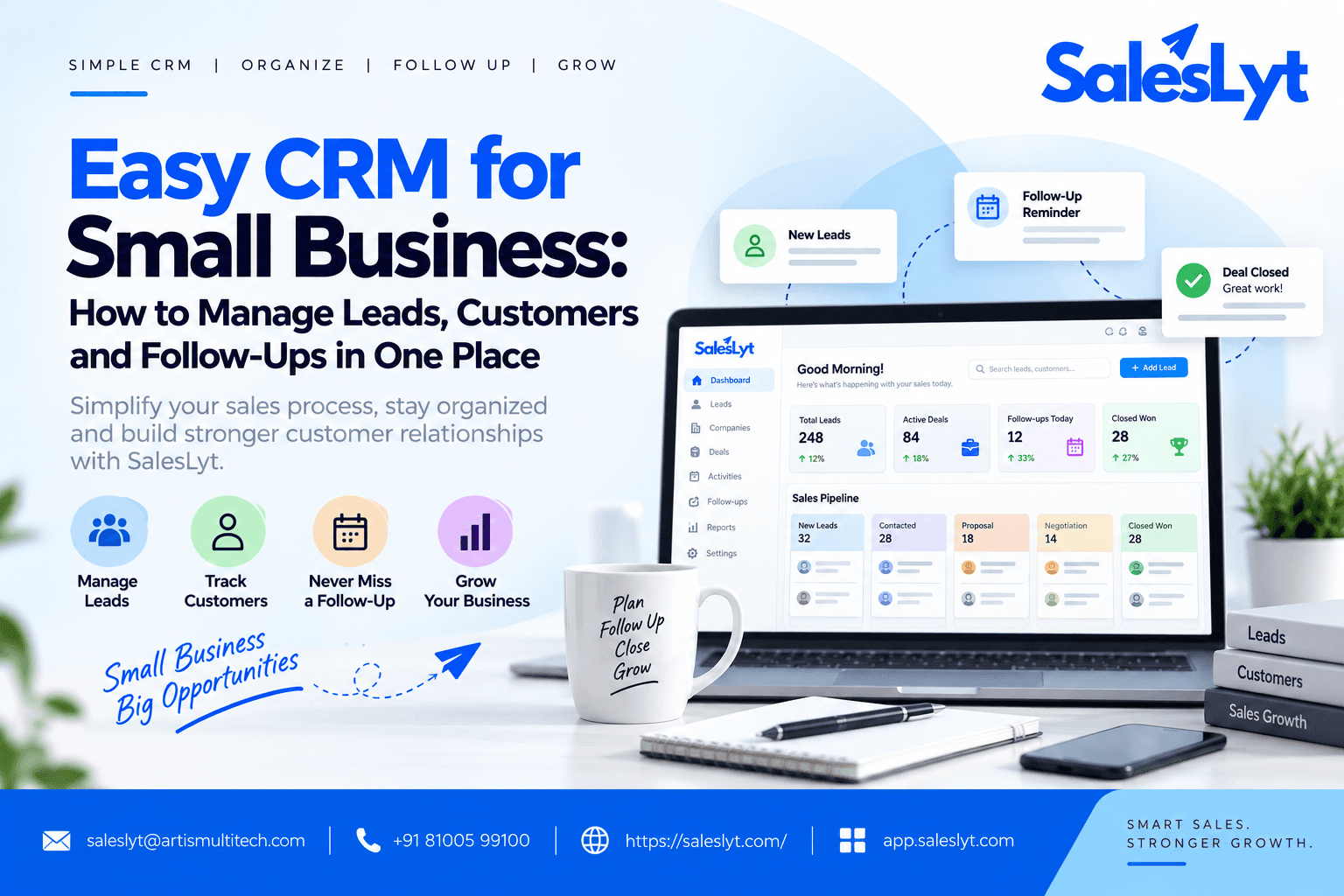
SalesLyt is designed to help growing businesses manage leads, customers, follow-ups, pipelines, and sales activities from one place. By combining CRM features with automation and AI-powered capabilities, it can support a more structured and efficient sales process.
If you are looking for the best CRM for small business or practical sales management software for small business, focus on a system that is simple to use, easy for your team to adopt, and flexible enough to support future growth.
Manage smarter. Follow up on time. Build stronger customer relationships with SalesLyt.