Running a small business in 2026 means managing more than customers. You are handling new enquiries, sales calls, follow-ups, quotations, meetings, opportunities, payments, and team performance—often at the same time.
For many small businesses, the problem is not a lack of leads. The real problem is keeping track of what happens after a lead arrives.
A prospect sends a WhatsApp message. Another enquiry comes through the website. Someone calls the sales team directly. Details are added to a spreadsheet, but the next follow-up gets missed. Before long, nobody is completely sure which opportunities are active and which ones have gone cold.
This is where the right CRM can make a difference. But choosing the best CRM for small business is not simply about finding software with the longest feature list. It is about choosing a system your team can actually use every day.
Here is what small businesses should look for before choosing a CRM in 2026.
1. Start With Ease of Use
A CRM only creates value when people consistently use it.
Small businesses rarely have dedicated CRM administrators or large IT teams. If the system requires extensive configuration, complicated training, or too many steps for basic activities, employees may gradually return to spreadsheets, notebooks, or messaging apps.
An easy CRM for small business should make common sales activities straightforward. Your team should be able to add leads, update customer information, record activities, schedule follow-ups, and check opportunities without unnecessary complexity.
When evaluating different CRM software for businesses, ask your salespeople to try the product rather than relying entirely on the feature page.
If they can understand the basic workflow quickly, that is a good sign.
2. Look for Strong Lead Management
Generating leads costs money and effort. Losing them because of poor tracking is avoidable.
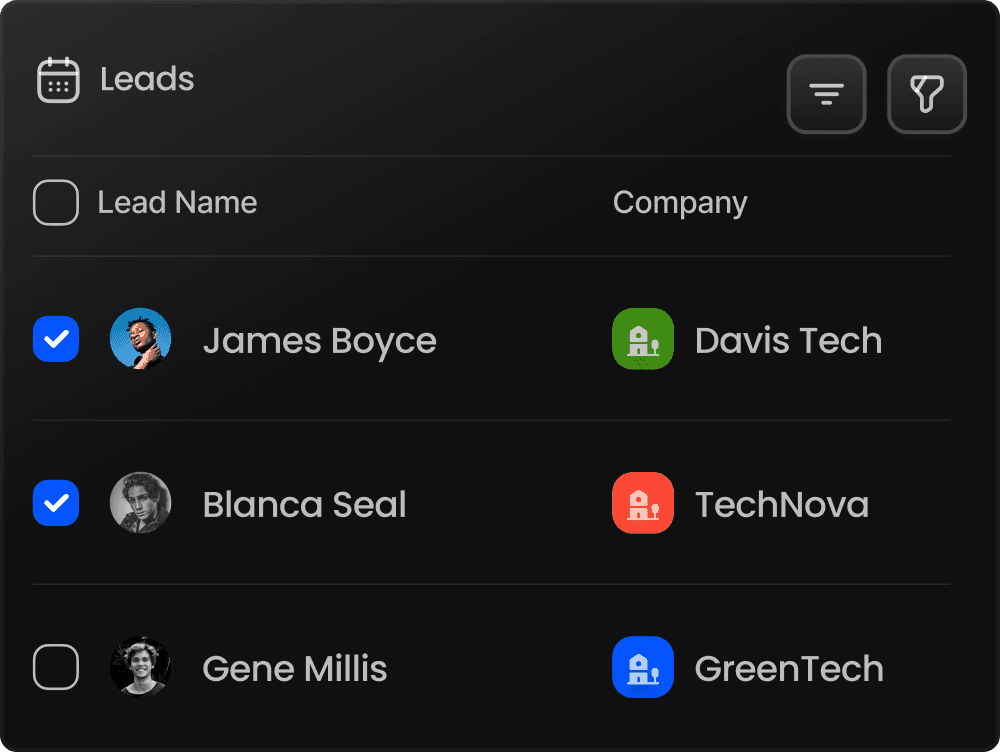
Good lead management software should provide one organized place for capturing and managing enquiries. Salespeople should be able to see where a lead came from, who is responsible for it, when the last conversation happened, and what needs to happen next.
For smaller teams, lead management software for small business becomes particularly useful as enquiry volume increases.
Instead of asking, “Did anyone follow up with this customer?”, the answer should already be visible in the system.
Effective sales lead management software also helps create accountability. Every lead can have an owner, status, activity history, and next action rather than remaining as another row in a spreadsheet.
3. Make Sales Pipeline Visibility a Priority
A list of contacts is not enough to manage sales.
You need to know how opportunities are progressing.
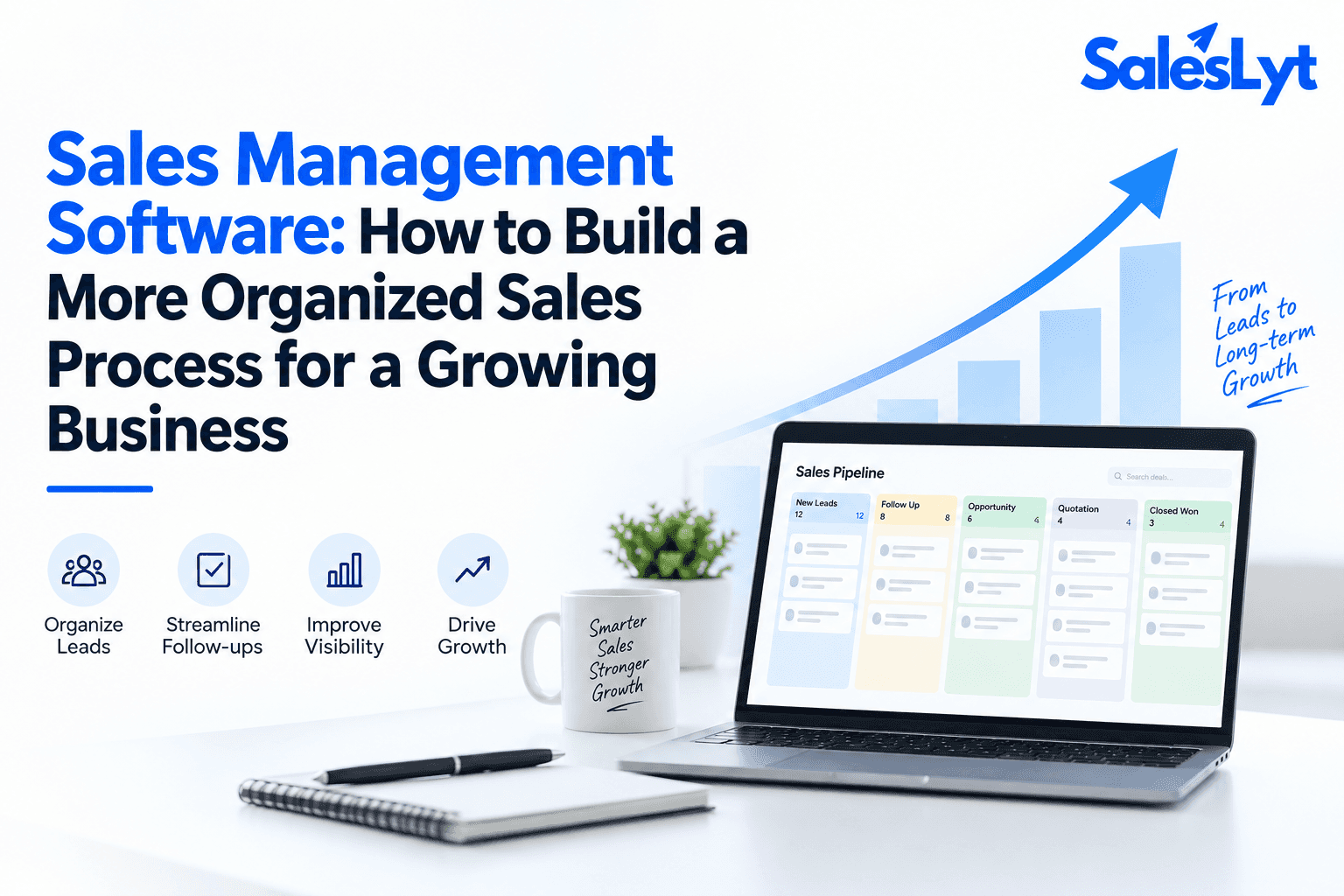
That is why sales pipeline management should be one of the first capabilities you examine. A useful CRM should show opportunities at different stages of your sales process and make it easy to understand what is moving, what is delayed, and what requires attention.
A practical sales pipeline tool can give managers a clearer picture of the business without requiring constant status meetings.
Similarly, a sales pipeline tracker helps salespeople understand their own priorities. They can quickly identify deals that require a call, meeting, quotation, or another follow-up.
This creates a more structured sales process and reduces dependence on individual memory.
4. Consider How AI Actually Helps Your Team
AI has become one of the biggest CRM trends, but having “AI” written on a product page does not automatically make a CRM more useful.
The important question is: what does the AI actually do?
Useful AI sales management software should help sales teams make better decisions or reduce repetitive work. That might include identifying important opportunities, providing recommendations, analyzing sales activity, scoring leads, or helping managers understand performance.
SalesLyt, for example, includes AI-powered insights and predictions designed to help teams assess deal outcomes and make data-driven decisions. It also provides AI performance scoring for leads, customer calls, and sales visits.
The purpose of AI-powered sales software should not be to replace the salesperson. It should help the salesperson understand where attention is needed and what action may be worth taking next.
5. Check Follow-Up and Activity Management
One missed follow-up can mean one missed sale.
Multiply that across several salespeople and dozens of prospects, and the impact becomes much bigger.
Before choosing a CRM, check how it manages calls, meetings, tasks, reminders, and follow-ups. Your team should have a clear view of what needs to be done today instead of searching through emails or personal notes.
Automation can also reduce repetitive administrative work.
For example, SalesLyt is designed to support automated reminders, follow-ups, email sends, and task assignments, helping teams maintain a more consistent sales process.
This is especially valuable when looking for sales management software for small business, where employees often manage several responsibilities at once.
6. Don't Ignore Sales Performance
Small business owners need visibility without micromanaging their salespeople.
Good sales performance management software should answer practical questions:
Which salesperson is performing well? How many opportunities are active? Where are deals slowing down? Are follow-ups happening consistently? What does the current pipeline look like?
Dashboards and performance metrics can turn everyday sales activity into information managers can actually use.
SalesLyt, for example, includes analytics dashboards, manager review capabilities, KPI tracking, task monitoring, productivity insights, and customizable dashboards.
The objective is not simply to collect more data. It is to make sales performance easier to understand and improve.
7. Think Beyond Basic Contact Management
As your business grows, sales activity becomes connected to other commercial processes.
A customer may move from lead to opportunity, then request a quotation, place an order, receive an invoice, and eventually make payment.
Managing each step through a different tool can create unnecessary administrative work.
Look for a CRM that can support more of your sales lifecycle. SalesLyt combines CRM functionality with quotation, invoice, and payment tracking capabilities, allowing businesses to manage more of the customer journey in one system.
This can be particularly useful for B2B businesses where closing the deal is only one part of the revenue process.
8. Check Whether the CRM Can Grow With You
The CRM you need with three salespeople may be different from what you need with 20.
Before making a decision, consider future requirements such as additional users, managers, dashboards, automation, permissions, reporting, and increased lead volume.
The best CRM for startups should provide enough simplicity for the current team while leaving room for growth.
Similarly, sales CRM for startups should help establish a structured sales process early instead of forcing the business to rebuild its entire system after expansion.
Agencies have slightly different requirements. A sales CRM for agencies may need to manage multiple prospects, organizations, conversations, proposals, follow-ups, and recurring business relationships simultaneously.
The right CRM should fit the way your business sells—not force your business into an unsuitable process.
9. Review Security and Data Protection
Your CRM contains valuable information: customer details, contacts, sales conversations, commercial opportunities, quotations, invoices, and performance data.
Security therefore deserves serious consideration.
Look at user permissions, access controls, encryption, audit capabilities, backups, and privacy features.
SalesLyt highlights multi-tenant isolation, role-based access control, encryption, audit logs, and privacy controls designed around DPDP compliance requirements.
For a growing business, security should not become important only after something goes wrong. It should be part of the CRM evaluation from the beginning.
10. Evaluate Value, Not Just Price
The cheapest CRM is not always the least expensive option.
If your team finds a system difficult to use, misses follow-ups, spends hours entering data, or requires multiple additional tools, a low subscription price may not represent good value.
Instead, compare the total benefit.
Does the CRM save time? Does it make the pipeline clearer? Can managers get useful reports? Does it reduce missed follow-ups? Can your team adopt it without months of training?
A CRM that helps your sales team work consistently can provide far more value than one selected purely because it has the lowest monthly fee.
Where SalesLyt Fits
SalesLyt is designed for startups, agencies, sales teams, and growing businesses that want to organize customer relationships and sales execution in one place.
Its capabilities include lead tracking, smoother sales pipelines, AI-powered insights and predictions, geo-tagging, AI performance scoring, analytics, manager reviews, automated activities, customizable dashboards, and integrated quotation and invoice management.
Instead of treating CRM as simply a database of customer records, the goal is to help teams manage the activities that move opportunities toward revenue.
For small and growing B2B businesses, that distinction matters.
Final Thoughts
Choosing the best CRM for small business in 2026 should start with your sales process—not with a comparison of hundreds of features.
Look for a system that is easy to adopt, keeps leads organized, improves sales pipeline management, supports consistent follow-ups, gives managers useful performance visibility, and uses AI in ways that genuinely help the sales team.
Most importantly, choose software your team will actually use.
Because the best CRM is not necessarily the one with the most features. It is the one that helps your business turn scattered sales activity into a clear, repeatable process—and ultimately, more customers and more predictable growth.

Conclusion
Choosing the best CRM for small business in 2026 is about finding a solution that makes selling simpler, more organized, and easier to scale. The right CRM should help your team manage leads, maintain timely follow-ups, improve sales pipeline management, monitor performance, and use AI-powered insights to make smarter sales decisions.
SalesLyt brings lead management, pipeline tracking, sales activities, automation, AI-driven insights, and performance visibility into one platform. For growing businesses that want to move beyond spreadsheets and disconnected tools, it provides a more structured way to manage the complete sales process.
Ready to build a smarter, more predictable sales process? Explore SalesLyt and see how your team can manage leads, opportunities, and sales growth from one place.