Growth is exciting for any business. More enquiries come in, the sales team gets busier, existing customers need attention, and new opportunities begin appearing from different sources.
But growth also creates a problem that many businesses notice only after it starts affecting sales: the process becomes harder to control.
One salesperson keeps lead details in a spreadsheet. Another relies on WhatsApp messages. Follow-up dates are saved in calendars or personal notes. Quotations are maintained somewhere else. When a manager asks which opportunities are likely to close this month, getting a clear answer can take several calls and messages.
The team may be working hard, but the sales process is no longer organized.
This is where sales management software becomes useful.
Instead of managing leads, customers, follow-ups, deals, and activities through separate systems, businesses can create one structured sales process that everyone follows.
The goal is not simply to introduce another piece of software. It is to give the team a clear way to answer three everyday questions:
Who should we contact? What needs to happen next? Which opportunities need attention?
For a growing business, getting these basics right can make sales management considerably easier.
Why Sales Becomes Harder as a Business Grows
In the early stages of a business, the founder may personally know almost every customer and opportunity.
If there are 15 active leads, remembering an important conversation is manageable.
Now imagine the same business a year later.
There may be 200 leads, several salespeople, enquiries coming from the website and social media, customer visits, quotations waiting for decisions, follow-ups scheduled for different dates, and existing customers asking for new requirements.
The informal process that worked earlier begins showing cracks.
Common problems start appearing:
Leads are entered in different places
Follow-ups are forgotten
The same customer may be contacted by two people
Salespeople do not always update managers
Old opportunities remain in the pipeline indefinitely
Customer conversations become difficult to trace
Managers cannot see what the team is working on
Quotation and payment information is disconnected from sales activity
Important opportunities receive attention too late
These are not always salesperson problems.
Very often, they are process problems.
When there is no central system, even a capable sales team can struggle to stay organized.
What Is Sales Management Software?
Sales management software is a system that helps a business organize and monitor its sales activities from the initial enquiry through follow-up, opportunity management, deal progress, and customer relationship management.
Instead of depending on individual spreadsheets and personal reminders, the team works from a shared system.
A typical process may look like:
New Lead → Qualification → Follow-Up → Opportunity → Quotation → Negotiation → Closed Deal → Customer
Each business may use different stages, but the principle is the same.
Everyone should know where an opportunity stands and what needs to happen next.
Modern sales CRM software can also combine customer information, tasks, activity history, pipeline visibility, reporting, automation, and increasingly AI-based insights.
That makes the CRM more than a digital address book.
It becomes part of the way the sales team works.
Start by Building a Clear Sales Process
Buying software before defining your process often leads to another problem: people start using the CRM differently.
One salesperson may consider a contact an opportunity immediately.
Another may keep it as a lead for several weeks.
One person updates every conversation, while another updates the system only when a deal closes.
Before configuring any CRM management system, define a simple sales journey.
For example:
1. New enquiry
A potential customer contacts the business.
2. Qualified lead
The team confirms that the prospect has a genuine requirement and is worth pursuing.
3. Follow-up
A salesperson contacts the prospect and records the next action.
4. Opportunity
There is a realistic possibility of business.
5. Quotation or proposal
Pricing or a formal offer is shared.
6. Negotiation
Commercial or technical discussions continue.
7. Won or lost
The outcome is recorded.
Your stages do not need to be complicated.
In fact, a shorter process that the team actually follows is usually more useful than a sophisticated workflow nobody updates.
Keep Every Lead in One Place
One of the first improvements a growing business can make is centralizing its leads.
Imagine receiving enquiries from:
Website forms
Phone calls
Email
Social media
Referrals
Exhibitions
Existing customers
Field sales representatives
If every channel creates a different list, the team quickly loses visibility.
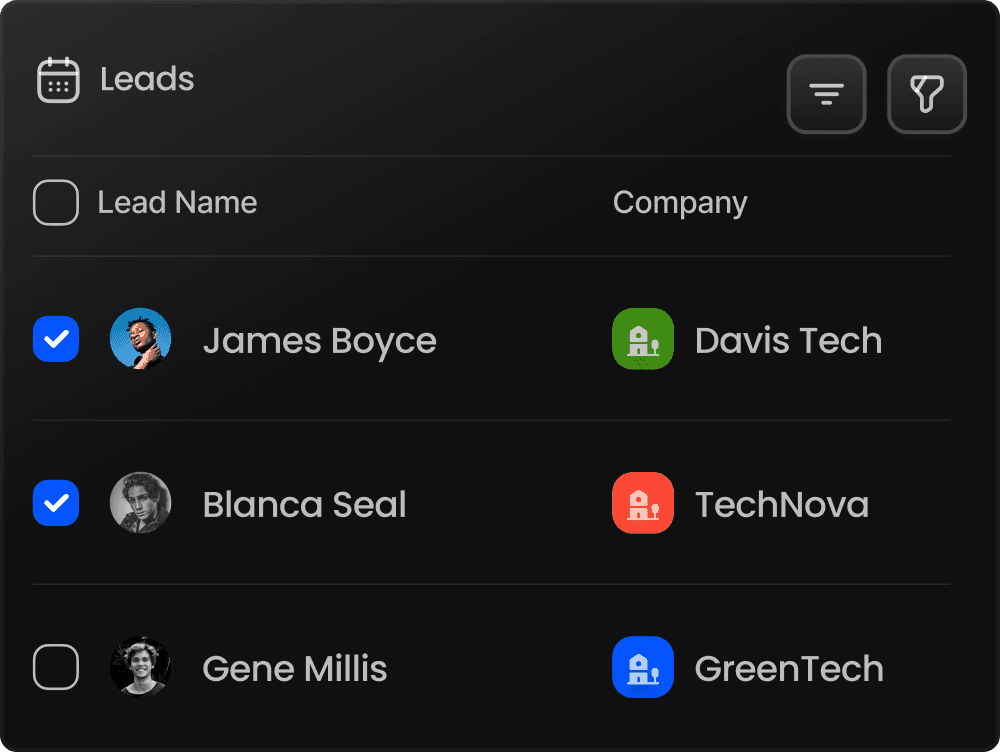
Good lead management software gives each lead a proper record containing information such as contact details, company, source, assigned salesperson, activity history, status, requirement, next action, and follow-up date.
This immediately changes the way the team works.
Instead of asking:
“Does anyone remember what happened with this customer?”
the team can check the record.
A proper lead management system also makes accountability clearer. When every important lead has an owner and next action, opportunities are less likely to disappear simply because everyone assumed someone else was handling them.
Make Follow-Up Part of the Process
Many deals do not close after the first conversation.
A prospect may say:
“Call me next Tuesday.”
“Send the quotation first.”
“We will discuss this after our internal meeting.”
“Contact us again next month.”
These conversations are completely normal.
The problem begins when the next action depends entirely on someone's memory.
A salesperson handling dozens of conversations cannot realistically remember every commitment.
A CRM should help turn follow-up into a structured activity.
Every meaningful conversation should ideally end with one of three outcomes:
Next action + responsible person + due date
For example:
Action: Discuss quotation
Owner: Rahul
Due date: 14 October
That small discipline can make a major difference.
Rather than beginning the morning by scrolling through messages and trying to remember whom to contact, salespeople can open their planned follow-ups and start working.
Give Managers a Clear View of the Sales Pipeline
A growing business needs more than a list of customer names.
Managers need to understand how opportunities are moving.
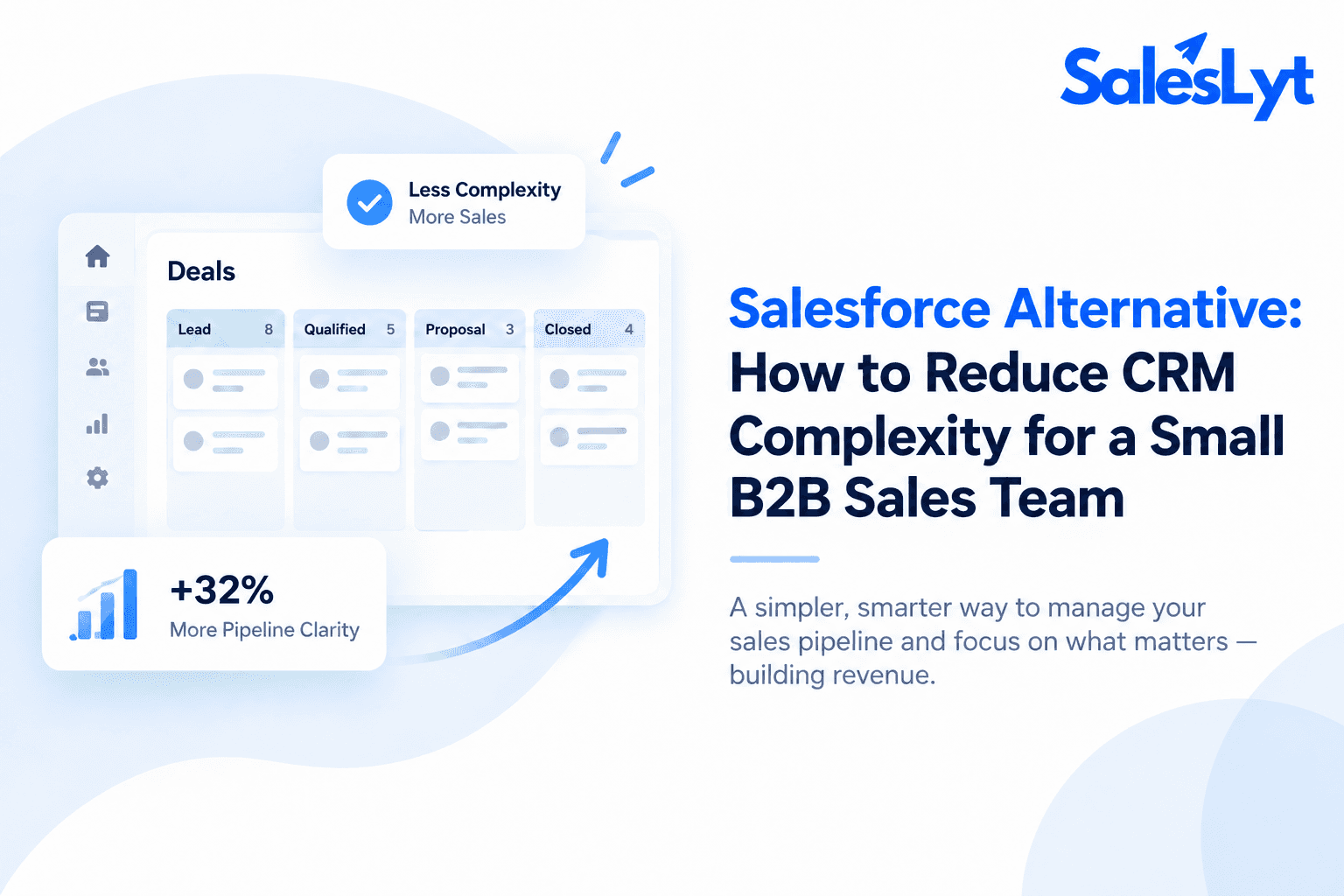
A sales pipeline management CRM can organize deals according to stages so that the team can see what is new, what is progressing, and what may be getting stuck.
Suppose the pipeline shows:
35 qualified leads
18 active discussions
12 quotations sent
7 negotiations
4 deals nearing closure
That information is much more useful than simply knowing that the company has 76 leads.
Managers can begin asking better questions.
Which quotations have received no response?
Which deals have remained in the same stage for too long?
Which opportunities have no future follow-up scheduled?
Where is the team spending most of its time?
Which deals need management involvement?
A pipeline should help people take action, not merely produce an attractive dashboard.
Build a System That Salespeople Will Actually Use
This is especially important when selecting CRM software for small businesses.
A business may buy a platform with hundreds of features, but those features are worthless if salespeople find the system too difficult to update.
The everyday workflow should be straightforward.
A salesperson should be able to:
Add a lead
Record a conversation
Schedule a follow-up
Update an opportunity
Check today's tasks
Find customer history
See what needs attention
without navigating through unnecessary complexity.
When evaluating a CRM for small businesses, usability deserves just as much attention as the feature list.
CRM adoption is ultimately a behavioural challenge.
If entering a sales update takes too long, people will postpone it.
Once updates are postponed, information becomes outdated.
Once information becomes outdated, managers stop trusting the CRM.
Eventually the team returns to spreadsheets and messages.
A useful system should fit naturally into everyday sales work.
Connect Lead Management With Customer Management
Lead management and customer management should not feel like completely separate activities.
A lead may eventually become:
Lead → Opportunity → Customer → Repeat Customer
That history has value.
Once a deal closes, the business should still be able to understand previous conversations, requirements, quotations, activities, and future opportunities.
That is one reason companies move toward a structured CRM for businesses rather than maintaining separate contact lists for prospects and existing customers.
The relationship continues after the first sale.
For B2B companies in particular, repeat orders, renewals, referrals, new projects, additional products, and account expansion can all become future revenue opportunities.
Make Your B2B Sales Process Visible
A B2B CRM software system becomes particularly useful because B2B deals often involve longer sales cycles.
A customer may move through several steps:
Enquiry → Discovery → Meeting → Site Visit → Technical Discussion → Quotation → Approval → Negotiation → Order
There may also be multiple people involved in the buying decision.
Without a central record, important context stays inside individual employees' phones and inboxes.
If that salesperson is unavailable, someone else may have very little understanding of the customer.
A structured CRM reduces this dependency on individual memory.
The customer relationship starts belonging to the business rather than only to the salesperson managing it.
Use Automation Where It Removes Repetitive Work
Automation should not replace genuine customer conversations.
It should reduce the administrative work around them.
For example, a CRM can help teams automate or simplify activities such as:
Follow-up reminders
Task assignments
Sales notifications
Routine workflow movement
Activity tracking
Repetitive sales tasks
The objective is simple: salespeople should spend less time maintaining the system and more time selling.
This is where the difference between a basic contact database and modern sales management software becomes more noticeable.
The software should support the process rather than create additional work.
Where AI Can Help the Sales Team
The next step in CRM technology is not simply storing more data.
It is helping teams make sense of the data they already have.
Modern AI-driven CRM software can potentially help sales teams identify patterns, prioritize work, analyze sales activity, and highlight opportunities that deserve attention.
For example, instead of a manager manually reviewing hundreds of records, AI-assisted tools may help surface leads or deals requiring closer attention.
SalesLyt currently positions AI-powered insights and prediction, AI performance scoring, sales analytics, automated task planning, pipeline management, and automated follow-ups as parts of its sales management environment.
The important point is that AI should support salespeople rather than make the process harder to understand.
Useful AI answers practical questions such as:
Where should I focus today?
Which opportunity may need attention?
What is happening across my pipeline?
Technology becomes valuable when it turns information into a clearer next action.
How SalesLyt Can Help Organize a Growing Sales Process
SalesLyt is designed as an AI-powered CRM and sales management platform for small businesses, startups, agencies, and growing B2B sales teams. Its current platform brings together areas including lead and customer management, sales pipelines, automated follow-ups, AI-powered insights and predictions, performance scoring, analytics, task management, quotations, invoices, payment tracking, geo-tagging, manager reviews, and customizable dashboards.
Instead of treating each sales activity as a separate task, the idea is to create a connected process.
For example:
Enquiry → Lead → Follow-Up → Opportunity → Quotation → Deal → Invoice → Payment
For a growing team, that continuity can be valuable because managers do not have to reconstruct the status of a customer from several different systems.
The objective is better visibility throughout the sales journey.
What to Look for When Choosing Sales Management Software
There are many CRM platforms available, and the longest feature list does not automatically make one the right choice.
When comparing options, ask practical questions.
Can the team manage leads easily?
Creating and updating leads should take very little time.
Can salespeople see their next follow-ups?
The system should make upcoming actions obvious.
Can managers see the pipeline?
Managers need visibility without repeatedly asking the team for updates.
Is customer history easy to understand?
Important conversations and activities should not be buried.
Can the software grow with the business?
A system that works for five people should not immediately become unsuitable when the team expands.
Does it reduce manual work?
Automation should simplify repetitive activities.
Does it provide useful reporting?
Reports should help managers make decisions, not just create charts.
Is the software easy enough for everyday use?
This may be the most important question of all.
The best CRM software for small businesses is not necessarily the one with the highest number of features.
It is the one the team consistently uses to run its sales process.
A Simple Way to Organize Your Sales Team
You do not need to redesign your entire sales operation overnight.
Start with a few rules.
Rule 1: Every genuine enquiry enters the CRM.
No important leads should remain only in someone's messages or notebook.
Rule 2: Every active lead has an owner.
Someone should always be responsible for moving the opportunity forward.
Rule 3: Every meaningful conversation has a next action.
Avoid leaving deals with vague statuses such as “interested.”
Rule 4: Every opportunity belongs to a defined pipeline stage.
This helps managers understand progress.
Rule 5: Review stalled deals regularly.
An opportunity that has not changed for weeks deserves attention.
Rule 6: Use the CRM during sales reviews.
If weekly meetings are based on separate spreadsheets, the CRM will never become the team's main system.
This approach keeps CRM management connected to actual selling.
Sales Organization Is More Important Than Having More Leads
Businesses naturally focus on generating more leads.
More website traffic.
More advertisements.
More enquiries.
More contacts.
But adding leads to a disorganized sales process can simply create a larger pile of missed opportunities.
Before asking, “How can we generate 500 more leads?” it is worth asking:
Are we properly managing the leads we already have?
Can you see who needs a follow-up today?
Can you identify quotations that have gone quiet?
Can managers see which deals are moving?
Does every salesperson know their priorities?
Can you understand why deals are being won or lost?
If the answer to several of these questions is no, improving the sales process may create more value than simply adding another lead source.
Final Thoughts
A growing business eventually reaches a point where spreadsheets, scattered messages, personal reminders, and memory are no longer enough to manage sales effectively.
That does not mean the sales process needs to become complicated.
Quite the opposite.
Good sales management software should make the process easier to understand.
Leads should have owners.
Follow-ups should have dates.
Opportunities should have clear stages.
Managers should have visibility.
Customer history should stay organized.
And salespeople should know what they need to do next.
By combining sales CRM software, lead management software, pipeline tracking, CRM management, automation, and AI-assisted insights, businesses can create a sales process that remains structured even as the number of leads, customers, and salespeople grows.
SalesLyt is built around this idea: bringing leads, follow-ups, opportunities, customer relationships, sales activities, and broader sales lifecycle management into one connected environment.
Because a better sales system is not simply about keeping more records.
It is about creating enough clarity for your team to act on those records.
And as a business grows, that clarity can become one of the most valuable parts of the sales process.
Want to build a more organized sales process?
Explore SalesLyt and see how your team can manage leads, follow-ups, pipelines, customers, and sales activities in one place.
Website: https://saleslyt.com/

Conclusion
As a business grows, managing sales through spreadsheets, WhatsApp messages, personal reminders, and disconnected tools becomes increasingly difficult. A structured sales management system helps bring leads, follow-ups, opportunities, customer history, and sales activities into one organized process.
The aim is not to make sales management more complicated. It is to give every lead an owner, every follow-up a clear date, every opportunity a defined stage, and managers better visibility into what is happening across the pipeline.
SalesLyt is built around this connected approach, helping businesses manage leads, follow-ups, opportunities, customer relationships, and the wider sales lifecycle in one place. A better sales system is ultimately about giving your team the clarity needed to know what to do next and keep opportunities moving forward.