Running sales for a small manufacturing company is very different from managing a simple online sales funnel.
An enquiry may come from a distributor today, a factory buyer may request a quotation next week, and another prospect may require several calls and site visits before placing an order. Meanwhile, sales representatives are following up with dealers, procurement teams, contractors and existing customers.
When all this information is spread across Excel files, WhatsApp conversations, notebooks and individual employees, opportunities can easily be missed.
That is why choosing the right CRM for manufacturing companies in India can make a significant difference.
A manufacturing-focused sales CRM should help your team organize enquiries, track customer interactions, manage quotations, monitor follow-ups and understand which opportunities are actually moving towards an order.
Why Small Manufacturing Companies Need a CRM
Many small manufacturers initially manage their sales activities using spreadsheets and personal follow-up systems.
That may work when the company has a limited number of prospects. But as the number of dealers, distributors, industrial customers and enquiries increases, managing everything manually becomes difficult.
Typical problems include:
Customer information stored in different places
Missed follow-up calls
Quotations sent but never followed up
Limited visibility into sales representatives' activities
Difficulty identifying stalled opportunities
No clear view of the overall sales pipeline
Dependence on individual employees' memory
Difficulty tracking customer communication over long sales cycles
A CRM creates a central system where the sales team can manage these activities more consistently.
For companies searching for CRM software for MSME businesses in India, the objective should not simply be digitizing customer data. The system should make the entire sales process easier to manage.
What to Look for in a CRM for Manufacturing Companies India
Manufacturing sales can involve longer buying cycles, technical discussions, quotations, field visits and repeated follow-ups. Because of this, manufacturers should evaluate CRM software based on how well it supports their actual sales workflow.
1. Centralized Lead and Customer Management
Every enquiry should have a clear record.
Your CRM should allow the sales team to maintain prospect details, companies, contacts, conversations, activities and opportunity status in one place.
For example, when a manufacturer receives an enquiry from an industrial buyer, the salesperson should be able to see:
Contact information
Product or requirement details
Previous conversations
Follow-up history
Current opportunity stage
Next planned action
This reduces the risk of important customer information getting lost when responsibilities change between employees.
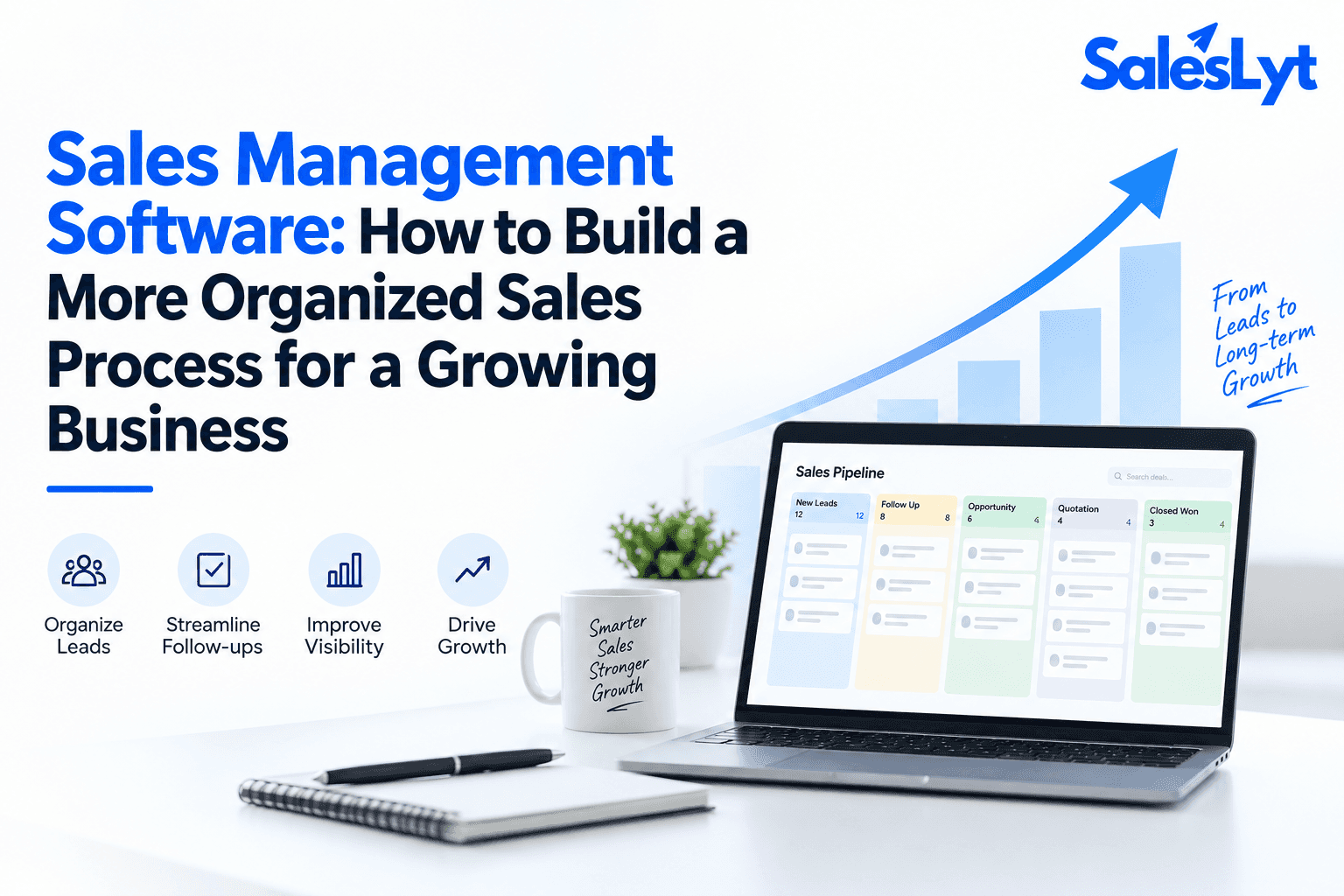
2. Structured Sales Pipeline
A manufacturing company may have opportunities at very different stages.
One prospect may have made an initial enquiry, another may be waiting for a quotation, while another could be negotiating commercial terms.
A structured pipeline helps categorize these opportunities.
Possible manufacturing sales stages could include:
New Enquiry → Qualified → Requirement Discussion → Quotation Sent → Negotiation → Order Expected → Won/Lost
This creates a clearer B2B sales process and allows managers to see where revenue opportunities are currently located.
Instead of repeatedly asking salespeople for updates, managers can review the pipeline and identify opportunities requiring attention.
3. Follow-Up Management
Follow-up discipline is especially important in B2B manufacturing.
Industrial purchases are rarely instant decisions. Prospects may compare suppliers, request revised quotations, wait for internal approval or delay purchases until a project begins.
Without reminders and structured follow-up management, promising opportunities can quietly disappear.
A CRM should help sales representatives identify:
Follow-ups due today
Overdue activities
Recently contacted prospects
Opportunities with no recent activity
Next actions for active deals
For manufacturers wondering how to improve sales process performance, creating a consistent follow-up system is often one of the most practical improvements they can make.
4. Quotation and Sales Lifecycle Tracking
Quotations play an important role in manufacturing and industrial sales.
Simply knowing that a lead exists is not enough. Teams need visibility into what happens after the quotation is shared.
Useful questions include:
Which quotations are currently open?
Which customers need a revised quotation?
Which opportunities are under negotiation?
Which quoted deals have stopped progressing?
Which opportunities have converted into orders?
Connecting these stages gives management better visibility into the complete sales journey.
SalesLyt includes CRM, quotation and invoice management capabilities designed to connect leads, sales activities and commercial processes within the same sales environment.
5. Field Sales and Visit Tracking
Many manufacturing businesses rely heavily on field sales.
Sales representatives may visit factories, distributors, dealers, contractors or project sites throughout the week.
For these companies, a CRM for industrial suppliers India should ideally provide visibility into field activity rather than only recording office-based communication.
SalesLyt, for example, includes geo-tagging for sales activities and tools for tracking sales visits and performance.
This can help managers understand field activity while giving representatives a structured place to record what happened during customer visits.
6. Sales Analytics and Performance Visibility
Manufacturing business owners should not have to wait until the end of the month to understand what is happening in sales.
A useful CRM should provide visibility into metrics such as:
Number of active leads
Opportunities by pipeline stage
Follow-ups completed
Stalled opportunities
Sales activities
Conversion performance
Salesperson activity
Pipeline movement
SalesLyt includes analytics dashboards, performance metrics and AI-powered insights intended to help sales teams understand their opportunities and activities more clearly.
How SalesLyt Can Fit a Small Manufacturing Sales Process
SalesLyt is an AI-powered CRM and sales management platform designed for small businesses and growing B2B sales teams.
For a manufacturing company, a workflow could look like this:
Step 1: A new industrial enquiry is added as a lead.
Step 2: The salesperson records the customer's requirements and schedules the next follow-up.
Step 3: Calls, visits and sales activities are recorded against the opportunity.
Step 4: The opportunity moves through the sales pipeline as discussions progress.
Step 5: A quotation is generated and associated with the customer opportunity.
Step 6: Follow-ups continue until the customer makes a decision.
Step 7: After conversion, invoices and payment-related activities can be tracked.
SalesLyt also provides AI-powered insights, predictions and performance scoring for leads, calls and visits, helping teams identify opportunities and sales activities that may require attention.
The goal is to provide sales teams with a connected view of the customer journey instead of managing each stage through separate spreadsheets and tools.
CRM vs Excel for Small Manufacturers
Excel remains useful for calculations and reporting, but it becomes increasingly difficult to use as the central system for a growing sales operation.
A spreadsheet can store customer names.
A CRM can help tell you what needs to happen next.
For example, a CRM can connect a customer with their previous interactions, opportunities, follow-up dates, quotation status, sales activities and pipeline stage.
This becomes particularly valuable when several salespeople are handling dozens or hundreds of active customer relationships.
For a small manufacturer planning to grow its dealer network, field sales team or B2B customer base, moving from disconnected spreadsheets to a structured CRM can create a more repeatable sales process.
Questions to Ask Before Choosing a Manufacturing CRM
Before selecting a CRM, evaluate it against your actual workflow.
Ask:
Can our team manage leads and customers easily?
Can we track long B2B sales cycles?
Can salespeople schedule and record follow-ups?
Can managers see the complete pipeline?
Can we manage quotations alongside opportunities?
Can field-sales activities be recorded?
Can management monitor team performance?
Is the system simple enough for our employees to adopt?
Can it support our process as the company grows?
The best CRM is not necessarily the platform with the longest feature list. It is the one your sales team can consistently use to manage everyday customer interactions.
FAQs
Which CRM is best for small manufacturing companies in India?
The right CRM depends on the company's sales process. Small manufacturers should prioritize lead management, follow-up tracking, pipeline visibility, quotation management, field-sales capabilities and reporting rather than choosing software based only on brand recognition.
How can CRM help a manufacturing business?
A CRM helps manufacturers centralize customer information, track enquiries, manage follow-ups, monitor quotations, organize sales opportunities and give managers better visibility into their sales pipeline.
Can small MSMEs use CRM software?
Yes. CRM software for MSME businesses in India can be particularly useful when a company begins handling more leads, salespeople, customers and follow-ups than spreadsheets can manage efficiently.
Is CRM useful for industrial suppliers?
Yes. Industrial suppliers often manage dealers, distributors, manufacturers and B2B buyers through repeated calls, meetings, quotations and field visits. A CRM can organize these activities within a structured sales process.
Conclusion: Choosing the Right CRM for Your Manufacturing Business
Choosing the right CRM for manufacturing companies India is ultimately about creating control over your sales process.
Small manufacturers do not need unnecessary complexity. They need a clear system for managing enquiries, customer relationships, follow-ups, quotations, sales activities and opportunities from one place.
When these activities are properly organized, salespeople know what they need to do next and managers gain a clearer picture of what is happening across the pipeline.
SalesLyt brings together lead management, pipeline tracking, automated follow-ups, AI-powered insights, field-sales capabilities, quotations, invoices and payment tracking for growing B2B sales teams.
If your manufacturing business is moving beyond spreadsheets and wants a more structured way to manage sales, explore SalesLyt at saleslyt.com and see how it can fit into your sales workflow.
Conclusion
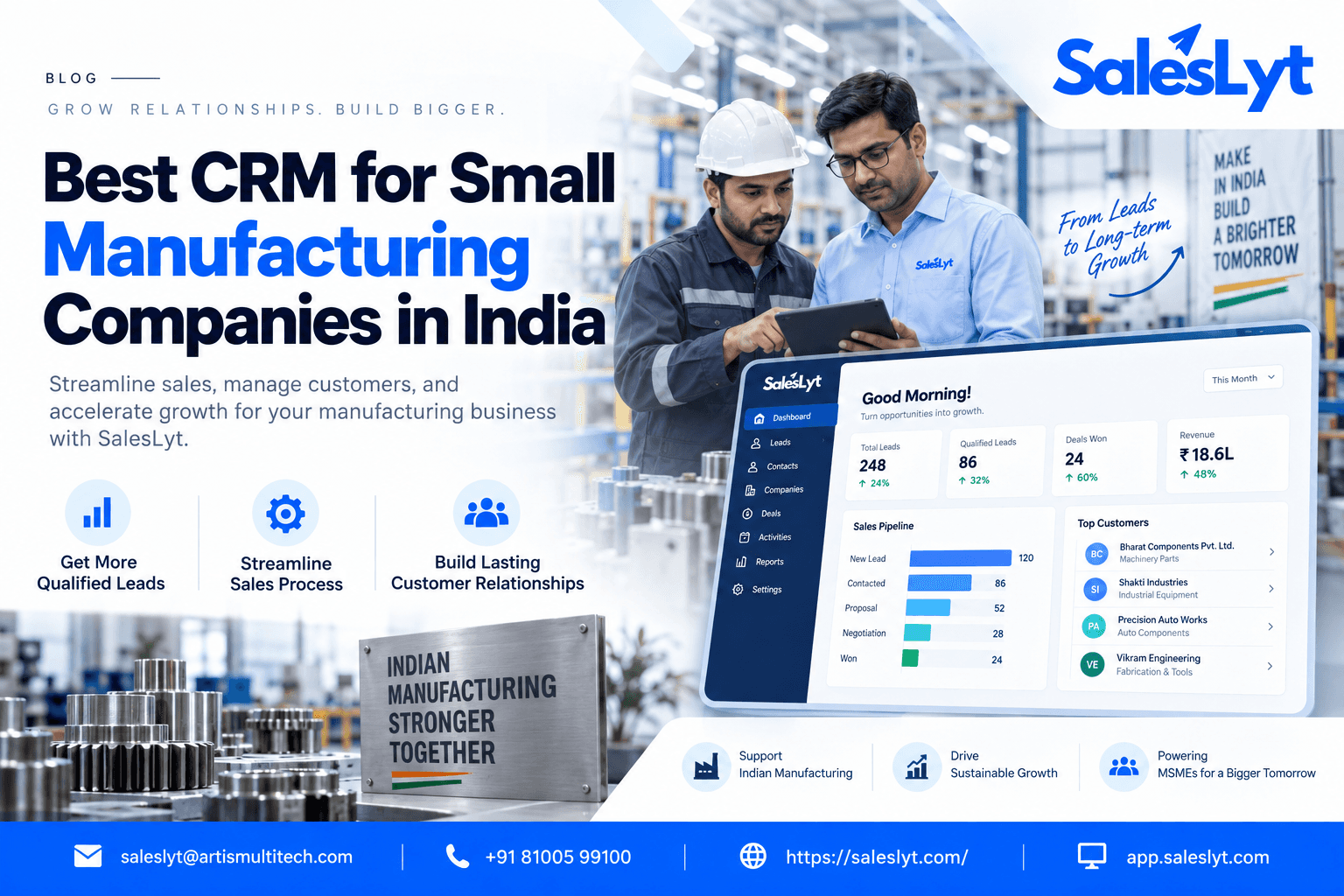
Choosing the right CRM for manufacturing companies in India is about creating a more organized and manageable sales process. Small manufacturers need a system that can centralize enquiries, customer relationships, follow-ups, quotations, field-sales activities, and opportunities without adding unnecessary complexity.
SalesLyt brings lead management, pipeline tracking, follow-ups, AI-powered insights, field-sales capabilities, quotations, invoices, and payment tracking into one connected platform for growing B2B sales teams. If your manufacturing business is moving beyond spreadsheets and wants better visibility and control over sales, SalesLyt can help you build a more structured process.