Running an agency means managing more than client projects. Every new enquiry needs a response, prospects need regular follow-ups, proposals have to be tracked, and existing client relationships need constant attention.
When an agency is small, this information often lives across spreadsheets, WhatsApp conversations, emails, notebooks, and individual team members’ memories. That may work for the first few clients. As the agency grows, however, the same approach can quickly become difficult to manage.
A good sales CRM for agencies creates a more organized way to handle the entire sales process—from the moment a lead arrives to the point where that prospect becomes a client.
Instead of asking, “Did someone follow up with this prospect?” your team can see what happened, what needs to happen next, and which opportunities deserve attention.
Why Sales Management Becomes Difficult as an Agency Grows
Agencies usually generate leads from multiple channels. A digital marketing agency, for example, may receive enquiries through its website, referrals, LinkedIn, Facebook campaigns, Google Ads, email, networking, and direct calls.
The problem isn't always generating leads. The bigger problem is managing them consistently.
Imagine receiving 40 enquiries in a month. Some want SEO services, others need social media management, website development, paid advertising, branding, or a combination of services.
Without proper lead management software, the team may record one prospect in Excel, another in WhatsApp and another in somebody's inbox.
A week later, nobody is completely sure which prospects received proposals or which ones need another call.
This is where structured CRM software for businesses becomes useful. It gives the team one place to organize sales information and maintain a clear history of each relationship.
1. Keep Every Agency Lead in One Place
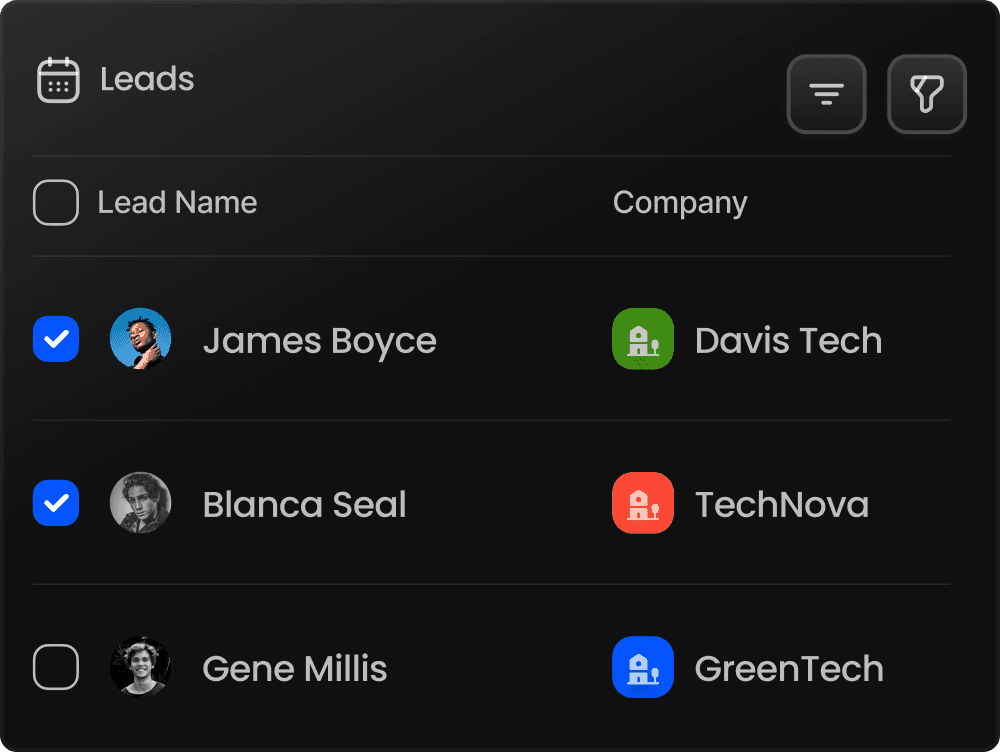
One of the first benefits of using sales lead management software is centralization.
Instead of maintaining different spreadsheets for website enquiries, referrals and campaign leads, agencies can create a single lead database.
Each lead can contain useful information such as:
Contact and company details
Lead source
Service requirements
Previous conversations
Assigned salesperson
Follow-up dates
Current sales stage
Estimated deal value
This also makes lead management software for small business valuable for growing agencies that don't yet have large sales departments.
When information is centralized, another employee can understand a prospect's history without searching through someone's messages or asking for an update.
2. Stop Losing Opportunities Because of Missed Follow-Ups
A prospect rarely becomes a client after one conversation.
They may say:
“Call me next Monday.”
“Send me the proposal.”
“We'll discuss this internally.”
“Contact me again next month.”
The problem starts when these commitments are not recorded properly.
A practical easy CRM for small business should make follow-ups visible and manageable instead of forcing employees to remember everything themselves.
For example, if a prospect requests another conversation after seven days, the salesperson can schedule the next activity immediately.
This creates accountability.
Rather than relying on memory, the agency builds a repeatable follow-up process. That becomes increasingly important when each salesperson is managing dozens of active conversations.
3. See Every Deal Moving Through Your Sales Pipeline
Not every lead has the same probability of becoming a client.
One prospect may have just submitted an enquiry. Another may already have attended a discovery call. A third may be reviewing your proposal.
Good sales pipeline management helps agencies separate these situations.
A typical agency pipeline might look like:
New Lead → Contacted → Discovery Call → Qualified → Proposal Sent → Negotiation → Won/Lost
Using a sales pipeline tool, the team can immediately understand where opportunities are sitting.
A visual sales pipeline tracker also helps answer practical questions:
Which deals haven't moved recently?
How many proposals are currently under discussion?
What is the potential value of the active pipeline?
Which salesperson needs support?
Instead of reviewing rows of disconnected spreadsheet data, managers get a clearer view of how opportunities are progressing.
4. Manage Client Relationships Beyond the Initial Sale
Agencies depend heavily on relationships.
Winning a client is important, but keeping that client can be even more valuable. Existing clients may renew retainers, purchase additional services or recommend the agency to other businesses.
That means a sales CRM for agencies shouldn't only be treated as a database of new leads.
It can become the central history of the relationship.
Your team can maintain client details, previous conversations, activities, opportunities and important follow-ups in one system. This becomes particularly useful when account managers, salespeople and managers all interact with the same customer.
Better visibility reduces communication gaps and helps the agency maintain a more professional client experience.
5. Use AI to Prioritize Sales Activities
The next generation of sales software is moving beyond simple data storage.
With AI sales management software, businesses can use sales data to understand opportunities and prioritize actions more intelligently.
For example, AI can help teams identify patterns, evaluate sales activities or highlight opportunities that may deserve attention.
This is where AI-powered sales software can add another layer to traditional CRM.
Instead of simply telling you that a deal exists, an intelligent system can help the team understand what's happening across the sales process.
For busy agency owners, this can be particularly valuable. They don't have time to manually inspect every lead and activity every day.
6. Measure Sales Team Performance
Agency managers also need visibility into what their sales team is actually doing.
How many leads are being followed up?
How many opportunities are progressing?
Which employees are consistently completing their activities?
Where are deals getting stuck?
This is where sales performance management software becomes useful.
Performance should not be measured only by the final revenue number. Managers also need visibility into the activities that contribute to revenue.
A structured system makes sales reviews more objective because decisions can be based on actual activity and pipeline information rather than incomplete verbal updates.
For agencies building dedicated business development teams, this visibility becomes increasingly important.
7. Connect Sales Activity With Revenue
Agencies don't simply need contacts—they need revenue.
That's why sales management software for small business should connect daily sales activities with opportunities and commercial outcomes.
For example:
A lead enters the system.
A salesperson qualifies the requirement.
A discovery call takes place.
An opportunity is created.
A proposal or quotation is shared.
The prospect negotiates.
The deal is won.
The customer is invoiced.
When these steps are connected, the agency gets a clearer picture of how its sales operation actually works.
Where SalesLyt Fits Into an Agency Sales Process
SalesLyt is designed for startups, agencies, sales teams and growing businesses that want a more structured way to manage customer relationships and sales activities.
For agencies, SalesLyt can bring several important parts of the sales process together, including lead management, automated follow-ups, organized sales pipelines, AI-powered insights, performance monitoring, task automation, quotations and invoice management.
Instead of managing sales through several disconnected tools, agencies can build a more organized workflow around one platform.
For an agency searching for the best CRM for small business, ease of use and practical sales execution can be just as important as having a long list of features.
The same principle applies when evaluating the best CRM for startups or a sales CRM for startups. A growing business needs software that supports its current process while giving the team enough structure to scale.
What Should an Agency Look for in a Sales CRM?
Before choosing a CRM, focus on how your team actually sells.
Your system should make it easy to capture leads, assign ownership, schedule follow-ups, track opportunities, maintain customer history, monitor team activity and review sales performance.
Most importantly, the CRM should be something your employees are comfortable using every day.
Complicated software can create another problem instead of solving one.
A useful CRM should reduce administrative work and give employees a clear answer to a simple question:
What should I do next?
Final Thoughts
Agency growth creates complexity.
Five prospects can be managed through memory and spreadsheets. Fifty active opportunities, multiple salespeople, proposals, client conversations and recurring follow-ups are much harder to control.
That's why implementing a structured sales CRM for agencies becomes increasingly valuable as the business grows.
With centralized lead management software, better sales pipeline management, automated follow-ups, performance visibility and AI-powered sales software, agencies can create a more consistent sales process instead of relying on scattered information.
The objective isn't simply to install another CRM.
It's to build a sales system where leads are organized, follow-ups happen on time, opportunities remain visible and managers know what's happening across the pipeline.
SalesLyt is built around that idea—helping growing teams organize relationships, manage their sales process and move more opportunities toward revenue.

Conclusion
Managing agency sales becomes much easier when leads, client conversations, follow-ups, and opportunities are organized in one place. A reliable sales CRM for agencies helps teams reduce missed follow-ups, improve sales pipeline management, track performance, and keep every potential deal moving forward.
With SalesLyt, growing agencies can bring their sales activities into a more structured system and use AI-powered sales software to improve visibility and make smarter sales decisions. The result is a more organized sales process, better team accountability, and more opportunities to turn leads into long-term clients.