Growing a sales team is exciting, but growth can quickly create new problems. Leads arrive from different channels, follow-ups get missed, salespeople maintain their own spreadsheets, managers struggle to understand what is happening in the pipeline, and customer information becomes scattered across multiple tools.
That is exactly where CRM software for businesses becomes valuable.
A modern CRM is no longer simply a digital address book. In 2026, businesses need a system that helps sales teams organize leads, manage opportunities, automate routine work, understand performance, and make better decisions using real sales data.
But with so many CRM platforms available, how do you know what really matters?
Here are 10 features every growing sales team should look for when choosing a CRM.
1. Centralized Lead Management
The first requirement is simple: every lead should have a clear place to live.
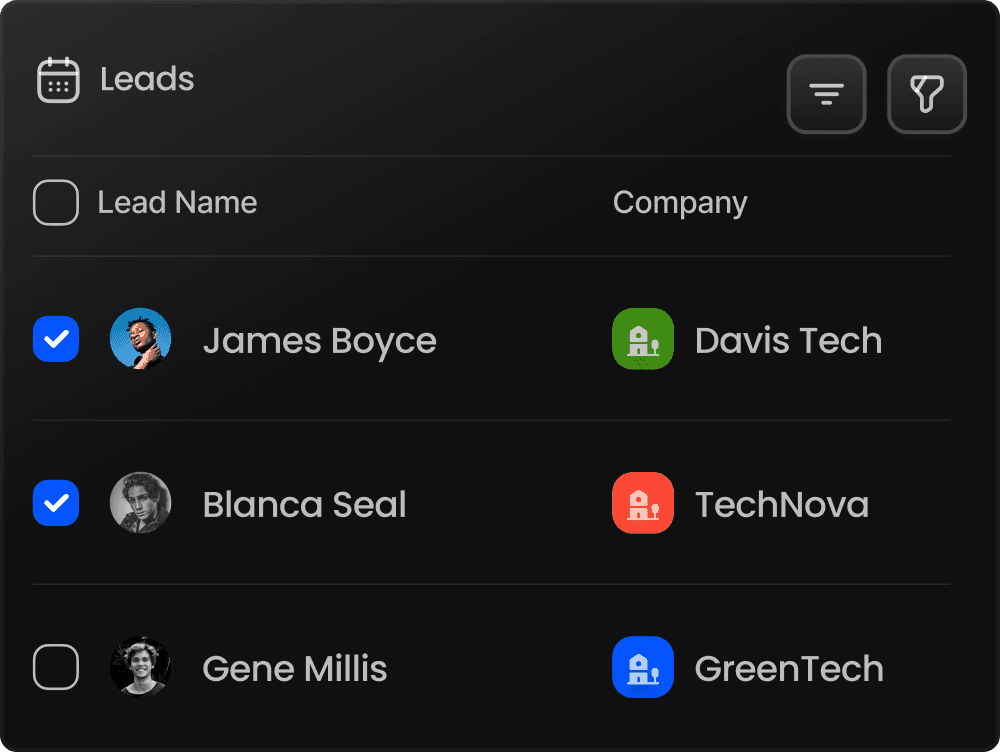
Good lead management software gives your sales team one organized system for storing prospect details, interactions, activities, follow-ups, and lead status.
This becomes increasingly important as lead volume grows. Managing 20 prospects in a spreadsheet might be possible. Managing hundreds of active leads across multiple salespeople is a completely different challenge.
Effective sales lead management software should make it easy for a salesperson to understand who the prospect is, what has already happened, and what needs to happen next.
For smaller companies, choosing the right lead management software for small business can also reduce dependency on scattered spreadsheets, notes, and individual employee records.
2. A Visual and Structured Sales Pipeline
Knowing how many leads you have isn't enough. You need to know where those leads are in the buying journey.
That makes sales pipeline management one of the most important CRM capabilities for a growing business.
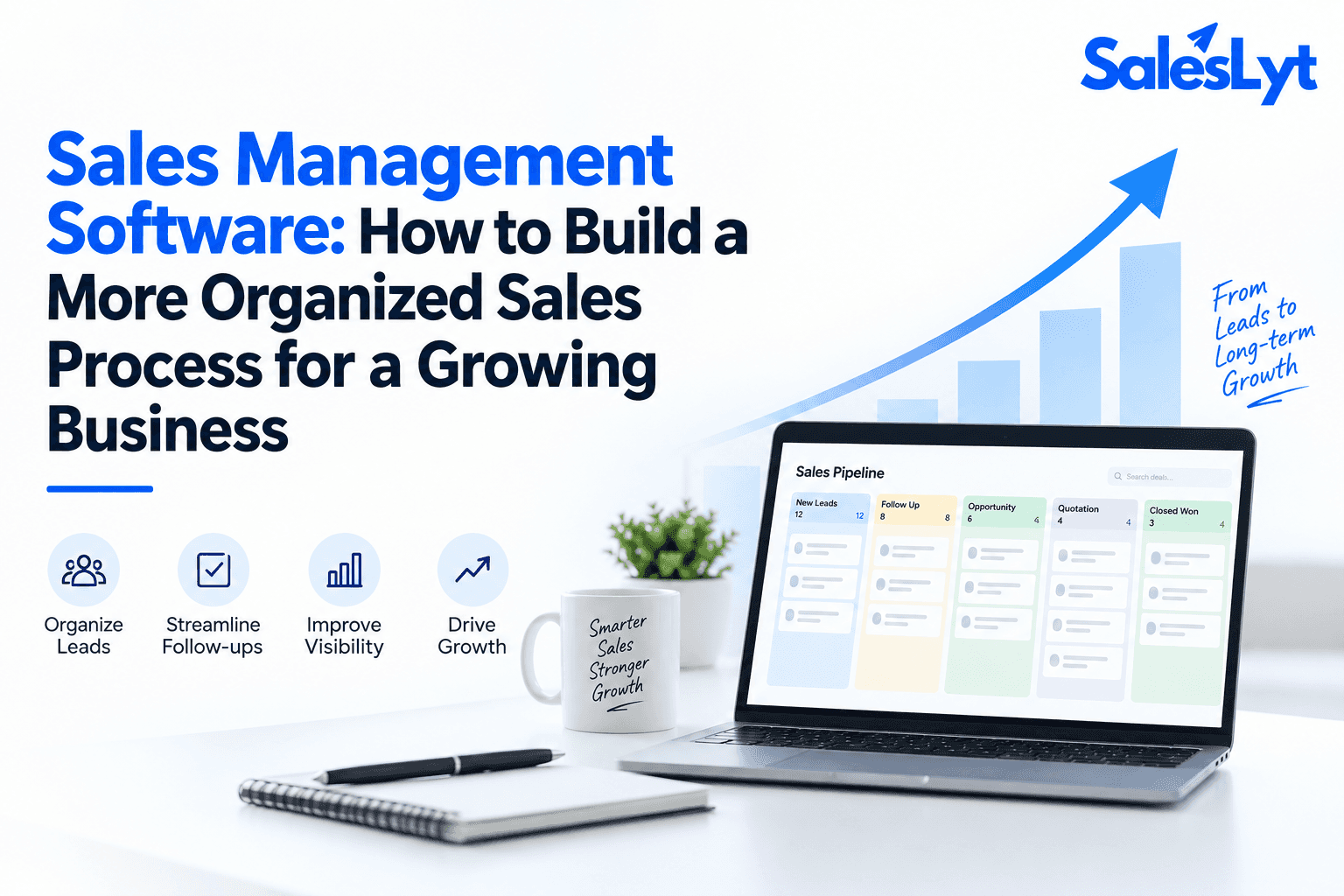
A useful sales pipeline tool organizes opportunities into meaningful stages so salespeople and managers can quickly see how deals are progressing.
Instead of asking everyone for an update, managers can use a sales pipeline tracker to identify active opportunities, stalled deals, and areas requiring attention.
SalesLyt, for example, highlights smoother sales pipelines that help teams track leads, automate follow-ups, and move deals through a more organized sales process.
3. Follow-Up and Task Automation
Many deals are lost for a surprisingly simple reason: nobody followed up at the right time.
Salespeople are constantly switching between calls, meetings, emails, customer visits, proposals, and internal tasks. Relying entirely on memory eventually creates gaps.
Your CRM should help automate reminders, follow-ups, task assignments, and repetitive activities.
Automation doesn't replace the salesperson. It removes unnecessary administrative work so the salesperson can spend more time communicating with prospects and moving opportunities forward.
For businesses evaluating sales management software for small business, this is particularly useful because smaller teams often have limited time and resources.
4. AI-Powered Sales Intelligence
Artificial intelligence has become one of the biggest changes in modern CRM.
Traditional systems primarily record what happened. Modern AI sales management software can help teams understand what their sales data may be telling them.
That can include identifying promising opportunities, highlighting risk, scoring activities, analyzing performance, and providing recommendations.
SalesLyt, for example, includes AI-powered insights and predictions designed to help teams assess deal outcomes and make more data-driven decisions. It also offers AI performance scoring for sales visits, calls, and leads.
This is where AI-powered sales software can become more than a database. It can help turn everyday sales activity into useful intelligence.
5. Sales Performance Analytics
A growing team needs visibility.
Managers should be able to answer questions such as:
Which salespeople are performing well?
How healthy is our pipeline?
Where are deals getting stuck?
Which activities are contributing to results?
How much progress are we making toward our targets?
Modern sales performance management software should provide dashboards, reports, KPIs, and performance insights without requiring managers to manually combine information from multiple spreadsheets.
SalesLyt includes analytics dashboards as well as manager review and performance capabilities for tracking KPIs, tasks, workflows, approvals, and productivity.
Better visibility allows managers to coach based on evidence rather than assumptions.
6. Contact and Relationship Management
Sales is ultimately about relationships.
Your CRM should maintain a structured history of prospects, companies, customers, conversations, and activities. When someone opens a customer record, they should be able to understand the relationship without searching through emails, notebooks, spreadsheets, and chat messages.
This is particularly important when multiple employees interact with the same account.
A centralized relationship history also protects the business when responsibilities change. Customer knowledge belongs to the organization instead of remaining with one salesperson.
That is a fundamental capability businesses should expect from modern CRM software for businesses.
7. Quotation, Invoice, and Payment Visibility
Sales doesn't necessarily end when a prospect says yes.
For many businesses, the process continues through quotations, invoices, payments, and ongoing customer management. Constantly moving between disconnected systems can create unnecessary friction.
A CRM that connects these stages gives teams better visibility into the complete sales lifecycle.
SalesLyt combines CRM functionality with quotation and invoice management, allowing businesses to manage leads, generate quotations and invoices, and track payments within a connected workflow.
For businesses trying to simplify their technology stack, this can be an important consideration.
8. Easy Adoption for the Sales Team
The most powerful CRM in the world provides little value if employees don't use it.
That's why usability should be a major factor when looking for an easy CRM for small business.
Salespeople should be able to understand their leads, tasks, activities, and opportunities without navigating unnecessarily complicated workflows.
The same principle applies when choosing the best CRM for small business. More features aren't automatically better. The right features should solve actual sales problems while keeping everyday work manageable.
Before committing to a platform, consider how quickly a new salesperson could learn the system and use it consistently.
9. Scalability for Startups and Growing Teams
A CRM should solve today's problems without becoming tomorrow's limitation.
A startup might initially have two or three salespeople. As the company grows, it may need managers, larger teams, more structured pipelines, stronger reporting, automation, security controls, and advanced analytics.
That's why companies searching for the best CRM for startups should think beyond their immediate requirements.
The right sales CRM for startups should provide enough simplicity for an early-stage team while offering room for processes to mature.
The same applies to service businesses. A sales CRM for agencies, for example, should make it easier to manage multiple prospects, client relationships, follow-ups, opportunities, and sales activities without creating additional administrative complexity.
10. Security and Access Control
CRM systems contain valuable business information: customer details, sales activity, quotations, pipeline data, communications, and potentially financial records.
Security therefore cannot be an afterthought.
Businesses should evaluate how a CRM handles access permissions, data isolation, encryption, auditability, and privacy.
SalesLyt highlights enterprise-grade security features including multi-tenant isolation, role-based access control, encryption, audit logs, privacy controls, and measures designed around DPDP compliance.
As your team grows, proper access management becomes increasingly important because different users may require different levels of visibility and control.
What Should Businesses Look for Before Choosing a CRM?
Don't choose a CRM simply because it has the longest feature list.
Start with your actual sales process.
Where are leads currently stored? How are follow-ups managed? Can managers see the pipeline clearly? How much time is spent preparing reports? Are quotations and invoices disconnected from customer information? Can your existing system support the next stage of growth?
Your answers will help determine which features actually matter.
The best CRM for small business or startup isn't necessarily the biggest platform. It is the one your team can use consistently while giving management the visibility needed to make better decisions.
Final Thoughts
In 2026, CRM has moved far beyond contact storage.
Growing sales teams need connected CRM software for businesses that can bring lead management, sales pipeline management, follow-ups, analytics, performance monitoring, automation, and sales intelligence together.
Solutions such as SalesLyt reflect this shift by combining AI-powered insights, organized sales pipelines, performance scoring, geo-tagging, automated activities, analytics, and integrated quotation and invoice management in one sales environment.
Whether you're evaluating sales performance management software, AI sales management software, the best CRM for startups, or an easy CRM for small business, focus on one question:
Will this CRM make it easier for our team to know what to do next and help management understand what is really happening in sales?
If the answer is yes, you're not simply buying another piece of software. You're building a more organized and scalable sales process.

Conclusion
Choosing the right CRM in 2026 is about more than simply storing customer information. Growing sales teams need a system that brings leads, follow-ups, pipeline management, automation, performance tracking, and sales intelligence together in one place.
The right CRM software for businesses helps teams stay organized, reduce missed opportunities, improve visibility, and make better decisions using real sales data. Features such as lead management software, sales pipeline management, automation, analytics, and AI-powered sales software can make everyday sales activities more efficient while giving managers greater control over performance.
As your business grows, choose a CRM that is easy for your team to adopt today and scalable enough to support tomorrow’s needs. With the right platform, your CRM becomes more than a database—it becomes the foundation for a smarter, more structured, and scalable sales process.