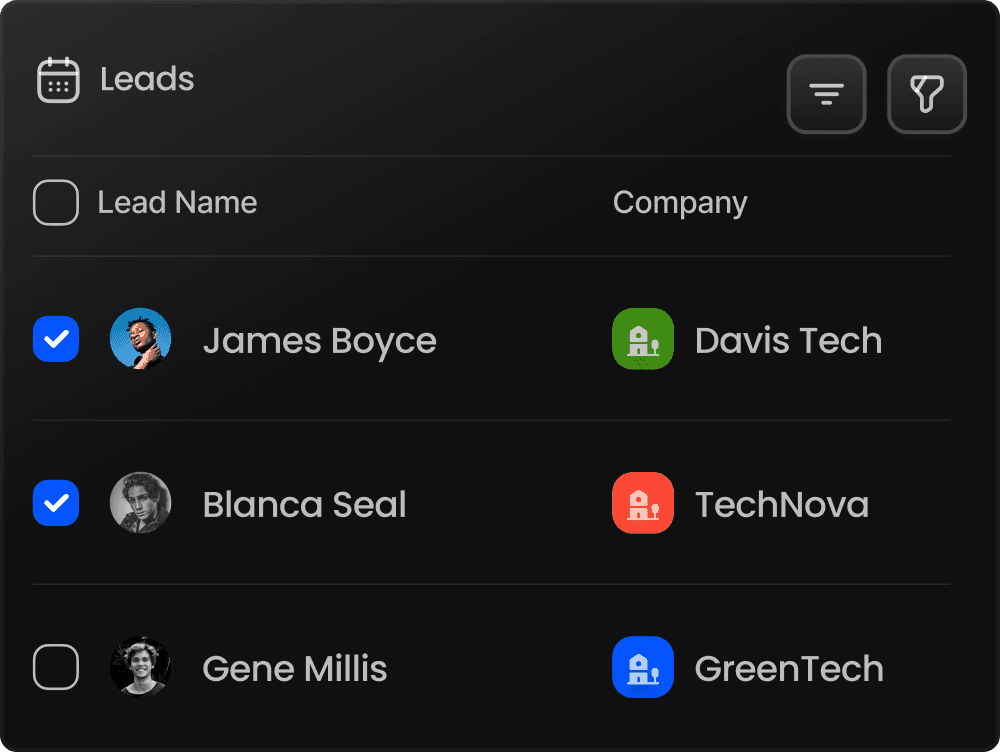
Generating leads is important, but getting someone's contact information does not automatically turn that person into a customer.
A potential buyer may submit an enquiry, call your business, request a quotation, respond to a campaign, or meet a salesperson. What happens after that first interaction often determines whether the opportunity moves forward or quietly disappears.
As the number of enquiries grows, keeping track of every conversation manually becomes difficult. Salespeople forget follow-ups, information gets scattered across spreadsheets and messages, and managers struggle to understand which prospects deserve attention.
This is where lead management software becomes valuable.
It gives businesses a structured way to capture, organize, follow up with, qualify, and convert leads while giving the sales team better visibility throughout the process.
What Is Lead Management Software?
Lead management software is a system that helps businesses manage potential customers from their first interaction until they become qualified sales opportunities or customers.
Instead of storing prospect information across spreadsheets, notebooks, emails, and messaging apps, businesses can keep important lead information in one organized system.
A typical lead management process may look like this:
Lead Captured → Contacted → Qualified → Follow-Up → Opportunity → Proposal → Won/Lost
The exact process will vary from one company to another, but the purpose remains the same: make sure every promising lead receives the right attention at the right time.
Modern sales lead management software can also connect lead information with tasks, follow-ups, opportunities, sales pipelines, performance data, and customer interactions.
Why Do Businesses Need Lead Management Software?
Imagine your company receives 50 new enquiries in a week.
Some come through your website, others through referrals, campaigns, phone calls, social media, or direct sales activities. If these leads are managed manually, salespeople may maintain separate spreadsheets or personal notes.
That works until the volume increases.
Soon, someone forgets to call a prospect back. Another salesperson does not know that a colleague has already contacted the same lead. A promising opportunity gets buried underneath newer enquiries.
A centralized CRM software for businesses helps reduce this confusion by giving the team a shared view of customer and prospect information.
Instead of asking, “What happened with this lead?” managers can see the progress and understand what action should happen next.
How Lead Management Software Helps Convert More Leads
1. It Keeps Your Leads Organized
Good lead management begins with organization.
Sales teams need more than a person's name and phone number. They may also need company information, lead source, requirements, previous conversations, follow-up dates, opportunity status, notes, and other relevant details.
Keeping this information together gives salespeople context before every interaction.
For small teams in particular, lead management software for small business can replace disconnected spreadsheets with a clearer, more manageable sales process.
The salesperson spends less time searching for information and more time communicating with prospects.
2. It Reduces Missed Follow-Ups
Many deals are not lost because the prospect said no. They are lost because the conversation simply stopped.
A salesperson may promise to call on Friday but become busy with meetings. Another prospect may ask to be contacted next month. Without a reliable system, those commitments are easy to forget.
Lead management software can help teams schedule and monitor follow-up activities.
SalesLyt, for example, highlights automated follow-ups and an intelligent automated task planner as part of its approach to keeping sales activity organized.
Regular follow-up keeps promising leads visible and reduces the chance that an opportunity disappears because nobody took the next step.
3. It Helps Teams Qualify Leads Better
Not every lead is ready to buy.
One prospect may have an immediate requirement and budget, while another may simply be researching available options. Treating both leads exactly the same can waste valuable sales time.
A structured system allows representatives to record information that helps determine how serious or relevant a lead is.
Modern AI sales management software can make this process more intelligent. AI can analyze available sales information, support prioritization, provide recommendations, and help teams identify patterns that might otherwise be missed.
SalesLyt includes AI-powered insights and predictions as well as AI performance scoring for leads, customer calls, and sales visits. These capabilities are designed to help teams make more informed sales decisions.
4. It Connects Leads With the Sales Pipeline
Lead management should not end once a prospect becomes interested.
Qualified leads need to move into a structured sales process.
This is where sales pipeline management becomes important.
A sales pipeline tool can show how opportunities progress through stages such as qualification, meeting, proposal, negotiation, and closure. A sales pipeline tracker then gives representatives and managers a clearer picture of which deals are moving forward and which ones have stalled.
Connecting lead management with pipeline management creates continuity.
Your team can follow a prospect from the initial enquiry through the sales conversation rather than starting with disconnected information at every stage.
5. It Gives Managers Better Sales Visibility
A sales manager should not have to wait for a weekly meeting to understand what the team is doing.
With organized lead and activity information, managers can see how leads are being handled, where opportunities stand, and whether important follow-ups are being completed.
When combined with sales performance management software, this visibility can also help managers evaluate productivity, identify bottlenecks, and support representatives who may be struggling at a particular stage.
SalesLyt supports this approach through dashboards, analytics, KPI-focused performance monitoring, manager review features, and AI performance scoring.
Better visibility allows managers to coach based on actual sales activity rather than assumptions.
6. AI Can Turn Sales Data Into Useful Insights
Traditional CRM systems were largely designed to store information. Modern AI-powered sales software can help businesses make better use of that information.
For example, AI can assist with analyzing sales activity, identifying patterns, scoring leads, predicting outcomes, and recommending actions.
That does not mean AI replaces salespeople.
Successful selling still depends heavily on communication, relationships, timing, and understanding customer needs. AI simply gives representatives additional information that can help them decide where to focus their attention.
An AI sales management software platform can therefore become particularly useful as a business grows and the amount of sales data becomes harder to analyze manually.
Choosing Lead Management Software for a Small Business
Small businesses often have different requirements from large enterprises.
They usually need simplicity, visibility, affordability, and quick adoption rather than unnecessary complexity.
When searching for the best CRM for small business, consider whether the system is genuinely easy for your team to use every day.
An easy CRM for small business should help employees manage contacts, leads, activities, follow-ups, and opportunities without creating additional administrative work.
Similarly, good sales management software for small business should give managers enough visibility to understand team performance while keeping the workflow practical for representatives.
The best system is not necessarily the one with the longest feature list. It is the one your team consistently uses.
Lead Management for Startups and Agencies
Startups often begin with spreadsheets because they are inexpensive and familiar. But as enquiries increase, the limitations become obvious.
The best CRM for startups should make it easier to establish a repeatable sales process early.
A well-designed sales CRM for startups can organize prospect information, follow-ups, pipeline activity, and sales conversations so that knowledge does not remain only in a founder's inbox or a salesperson's spreadsheet.
Agencies face similar challenges.
An agency may simultaneously manage leads for marketing services, development projects, consulting engagements, retainers, and other services. A sales CRM for agencies provides one place to track these prospects and their progress.
This becomes especially useful when several team members are involved in converting the same opportunity.
How SalesLyt Supports Lead Management
SalesLyt is positioned as a modern CRM for startups, agencies, sales teams, and growing businesses.
Its current feature set brings together lead tracking, automated follow-ups, smoother sales pipelines, AI-powered insights and predictions, AI performance scoring, analytics, task management, and manager performance monitoring.
SalesLyt also connects CRM activities with quotations, invoices, and payment tracking. This allows businesses to manage more of the sales lifecycle within a connected environment rather than separating lead generation, deal management, and post-sale commercial activities across multiple systems.
For teams looking to move away from fragmented sales processes, that connected approach can provide much-needed visibility.
Final Thoughts
Generating more leads is useful only when your business has a reliable process for managing them.
Effective lead management software helps your sales team organize prospects, remember follow-ups, prioritize opportunities, monitor progress, and maintain visibility from the first interaction through conversion.
When lead management is connected with sales pipeline management, analytics, automation, and AI-powered sales software, teams can spend less time managing scattered information and more time building customer relationships.
Whether you are evaluating the best CRM for small business, best CRM for startups, sales CRM for agencies, or simply looking for better sales lead management software, focus on one question:
Does the system make it easier for your team to take the right action with the right lead at the right time?
Because in the end, successful lead management is not about collecting the largest number of contacts. It is about making sure valuable opportunities do not get lost along the way.
Conclusion
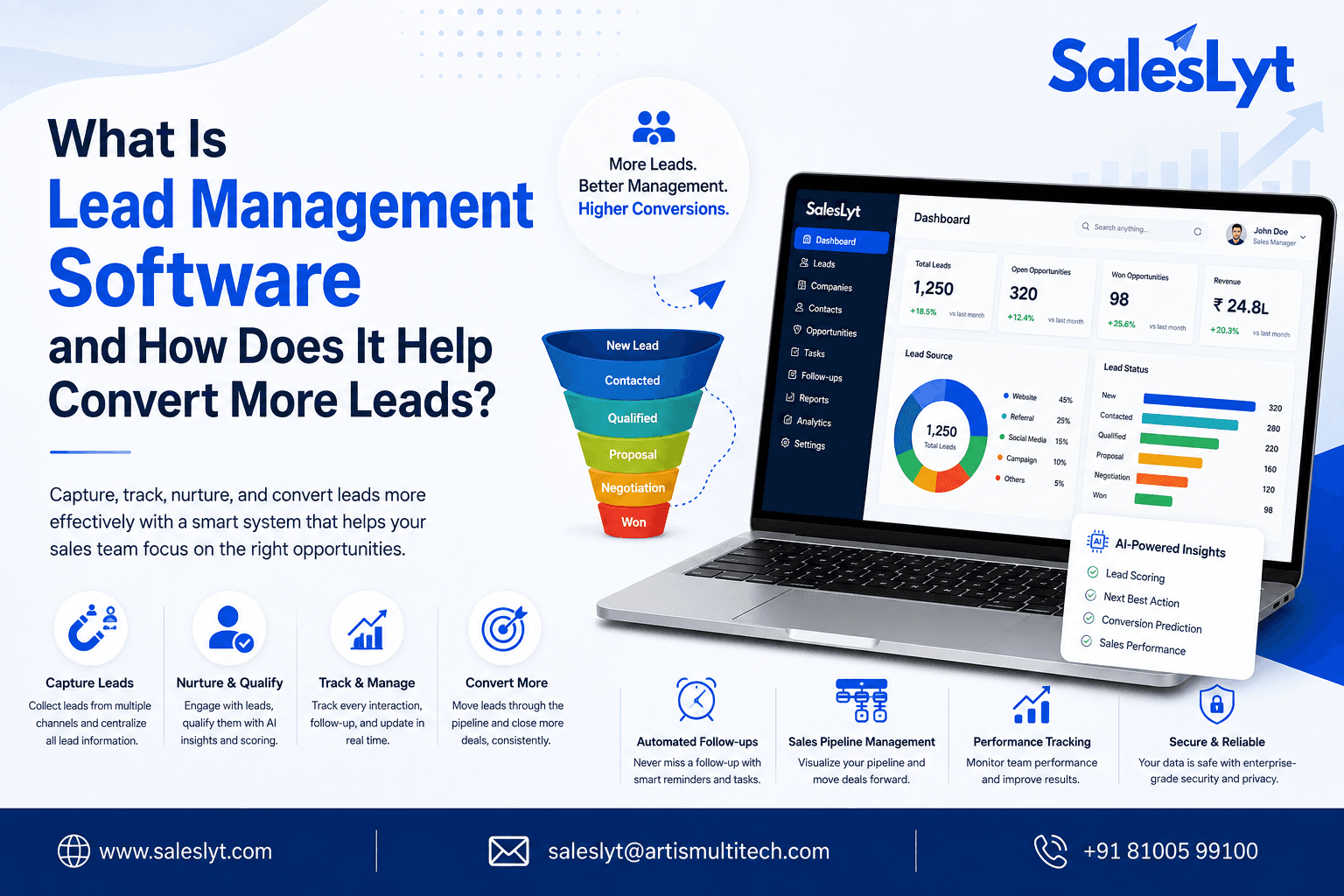
Effective lead management software helps businesses turn more enquiries into real sales opportunities by keeping leads organized, follow-ups on schedule, and every interaction visible to the sales team. When combined with sales pipeline management and AI-powered sales software, it becomes easier to prioritize promising leads, reduce missed opportunities, and make better sales decisions.
With SalesLyt, businesses can manage leads, follow-ups, opportunities, pipeline activities, and AI-powered insights in one place. A structured lead management process not only helps improve conversions but also gives your sales team the clarity and control needed for consistent business growth.


FAQ
What is FlowSuite and who is it for?
FlowSuite is a modern customer relationship management platform designed for startups, agencies, sales teams, and growing businesses.
Do I need technical experience to use FlowSuite?
Is my data secure on FlowSuite?
Does FlowSuite support team collaboration?
What kind of support do you offer?
Can I migrate my data from another CRM to FlowSuite?