Growing a startup is exciting, but sales can become complicated surprisingly quickly.
In the beginning, keeping customer details in spreadsheets, emails, WhatsApp conversations, or personal notes may seem perfectly manageable. There are only a few leads, the team is small, and everyone knows what is happening.
Then the business starts growing.
More enquiries arrive. More people join the sales team. Follow-ups increase. Deals move through different stages. Suddenly, nobody is completely sure which prospect needs attention, when a customer was last contacted, or why an opportunity has been sitting untouched for two weeks.
This is usually the point when choosing the best CRM for startups becomes less about buying software and more about building a reliable sales process.
Why Do Startups Need a CRM?
A CRM, or Customer Relationship Management system, gives your team one place to manage leads, customer interactions, sales opportunities, follow-ups, and related activities.
Good CRM software for businesses replaces scattered information with a connected view of the customer journey.
Imagine having 80 active prospects. Some are ready for a proposal, some need another call, some haven't replied, and others are still evaluating your product. Without a central system, important opportunities can easily disappear inside spreadsheets or message threads.
A sales CRM for startups helps answer practical questions such as:
Which leads should we contact today?
Which opportunities are moving forward?
Which deals have been inactive?
Who is responsible for each prospect?
What was discussed during the last interaction?
What should happen next?
That visibility becomes increasingly important as your team grows.
1. Start With Strong Lead Management
For most startups, leads come from several places: website forms, referrals, social media, advertising campaigns, events, direct enquiries, and outbound sales.
Managing all of them manually gets difficult.
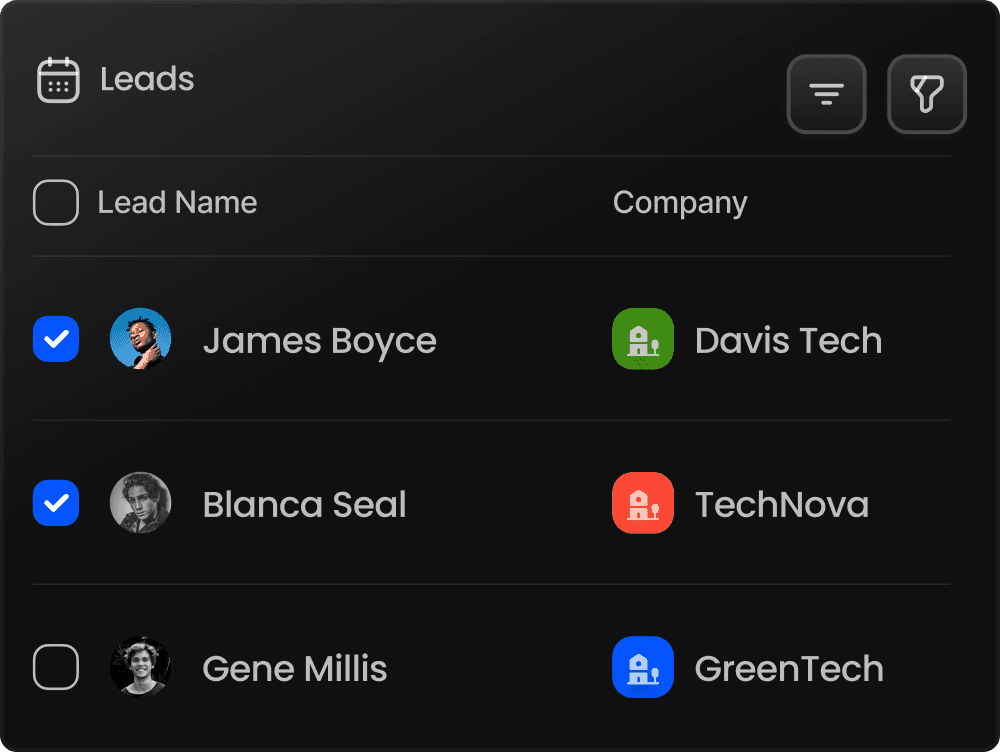
The right lead management software should make it simple to capture, organize, assign, and follow up with prospects. Instead of searching through different sources, your team should be able to see the lead's information and activity in one place.
More importantly, sales lead management software should help salespeople understand what needs attention next.
For smaller teams, choosing dedicated lead management software for small business can prevent leads from being forgotten while keeping the process simple enough for everyday use.
2. Look for Clear Pipeline Management
Generating leads is only the beginning. Startups also need to understand what happens after a lead enters the sales process.
This is where sales pipeline management matters.
A useful sales pipeline tool gives your team a visual understanding of where opportunities currently stand. Depending on your business, stages could look something like:
New Lead → Contacted → Qualified → Proposal → Negotiation → Won
A good sales pipeline tracker also helps founders and sales managers identify bottlenecks. If plenty of leads are entering the pipeline but very few are reaching the proposal stage, there may be a qualification or follow-up problem.
Without pipeline visibility, teams often focus on activity. With pipeline visibility, they can focus on progress.
3. Choose a CRM Your Team Will Actually Use
Startups don't usually have weeks to train employees on complicated software.
That's why usability matters.
An easy CRM for small business should make common activities straightforward: adding a lead, recording an interaction, scheduling a follow-up, checking the pipeline, or reviewing a customer.
The most feature-heavy CRM isn't automatically the best choice.
If employees avoid updating the system because it takes too much effort, the information inside it quickly becomes unreliable. And an outdated CRM isn't particularly useful, no matter how impressive its feature list looks.
When comparing the best CRM for small business, ask a simple question:
Can our team use this comfortably every day?
4. Think Beyond Contact Management
A growing startup eventually needs more than a digital address book.
Your CRM should help you understand how the sales team is performing.
This is where sales performance management software becomes useful. Managers need visibility into sales activities, follow-ups, opportunities, targets, and team performance without repeatedly asking employees for manual updates.
Similarly, sales management software for small business should help founders move from reactive management to a more structured sales process.
Instead of asking, "What happened with that customer?" during every review, managers should already have enough context to ask, "What should we do next to move this opportunity forward?"
That small change can make sales reviews far more productive.
5. Consider What AI Can Actually Do for Sales
AI is appearing in almost every business application, but startups should look beyond the label.
Useful AI sales management software should help your team make better decisions or reduce repetitive work.
For example, AI can help identify important opportunities, analyse sales activity, support lead prioritization, provide recommendations, or highlight areas that may need attention.
The value of AI-powered sales software isn't simply that it contains AI. The value comes from turning existing sales information into something your team can actually act on.
For a busy startup, that could mean spending less time searching through data and more time talking to the right prospects.
6. Make Sure the CRM Can Grow With You
The system that works for three people should not become a problem when the company grows to ten, twenty, or more.
Before choosing a CRM, consider what your sales operation could look like a year from now.
Will you need additional users? More structured permissions? Better reporting? Multiple pipelines? More automation? Manager dashboards? Quotations or invoicing?
Agencies should think about this carefully as well. A sales CRM for agencies may need to handle numerous client relationships, proposals, follow-ups, decision-makers, and opportunities at the same time.
Changing CRMs after your sales data and processes are deeply established can be disruptive. Choosing for tomorrow, rather than only for today, can save considerable effort later.
Where SalesLyt Fits In
SalesLyt is designed for startups, agencies, sales teams, and growing businesses that want to bring sales activities into a more connected workflow.
Rather than treating CRM as a place where customer records simply sit, SalesLyt focuses on helping teams manage the wider sales journey.
Its capabilities include lead and pipeline management, automated follow-ups, AI-powered insights and performance scoring, analytics dashboards, geo-tagging, manager performance visibility, and integrated quotation, invoice, and payment management.
For a growing startup, this means customer information, sales activities, opportunities, and business actions can remain connected as the team expands.
A Simple Checklist Before Choosing Your Startup CRM
Before committing to any platform, ask:
Can our team manage leads easily?
Can we clearly see every opportunity in the pipeline?
Can salespeople quickly identify their next follow-ups?
Can managers understand team and deal performance?
Does the platform reduce repetitive manual work?
Are its AI features useful for real sales decisions?
Can it support our business as the team grows?
Is customer and business data properly protected?
Can new employees learn the system without extensive training?
Does the CRM fit the way our company actually sells?
If the answer to most of these questions is yes, you're probably evaluating the right kind of system.
Final Thoughts
Choosing the best CRM for startups isn't about finding software with the longest feature list. It's about creating a sales process your team can consistently follow.
The right sales CRM for startups should give you control over leads, follow-ups, customer conversations, opportunities, and team performance without creating unnecessary administrative work.
Start with the problems your sales team faces today, but choose a platform capable of supporting where your business is going next.
As your startup grows, visibility becomes increasingly valuable. Knowing which leads matter, which deals need attention, and what action should happen next can turn a scattered sales operation into a repeatable growth process.
If you're looking for a CRM designed to bring leads, sales activity, pipeline visibility, AI-powered insights, and business workflows together, explore SalesLyt and see how it can support your growing sales team.

Conclusion
Choosing the best CRM for startups is about finding a system that makes sales easier to manage as your business grows. The right sales CRM for startups should help your team organize leads, track opportunities, manage follow-ups, monitor the sales pipeline, and understand what needs attention next.
Instead of relying on spreadsheets, scattered messages, and manual updates, a connected CRM gives your team better visibility and a more consistent sales process. With AI-powered sales software, startups can also use their sales data more effectively to prioritize opportunities and make smarter decisions.
SalesLyt brings lead management, pipeline tracking, sales activities, AI-powered insights, performance visibility, quotations, invoices, and follow-ups into one connected platform.
Ready to build a smarter sales process? Explore SalesLyt and discover how the right CRM can support your startup's next stage of growth.


FAQ
What is FlowSuite and who is it for?
FlowSuite is a modern customer relationship management platform designed for startups, agencies, sales teams, and growing businesses.
Do I need technical experience to use FlowSuite?
Is my data secure on FlowSuite?
Does FlowSuite support team collaboration?
What kind of support do you offer?
Can I migrate my data from another CRM to FlowSuite?