Choosing a CRM used to be mostly about storing customer information and tracking deals. That is no longer enough.
Today, small businesses are dealing with more leads, more follow-ups, more customer conversations and more pressure to close opportunities quickly. At the same time, artificial intelligence is becoming a practical part of sales management.
The right AI-powered CRM can help a team identify important opportunities, automate repetitive work, organize follow-ups and make better use of sales data.
But not every AI CRM solves the same problem.
If you are comparing the Top 10 AI CRM software for small businesses, the better question is not simply, “Which CRM has the most features?”
The better question is:
Which CRM fits the way my business actually sells?
Below are 10 AI CRM platforms worth comparing, starting with SalesLyt, along with the factors small businesses should evaluate before making a decision.
1. SalesLyt – AI-Powered CRM for Growing Sales Teams
SalesLyt is an AI-powered CRM and sales management platform designed for small businesses, startups, agencies and growing B2B sales teams.
Its focus goes beyond simply maintaining customer records. SalesLyt combines lead management, pipeline tracking, follow-up automation, sales analytics and AI-powered decision support in one system.
SalesLyt currently includes capabilities such as AI-powered insights and predictions, AI performance scoring, geo-tagging, pipeline management, automated follow-ups, customizable dashboards, quotation and invoice management, payment tracking, and manager performance monitoring.
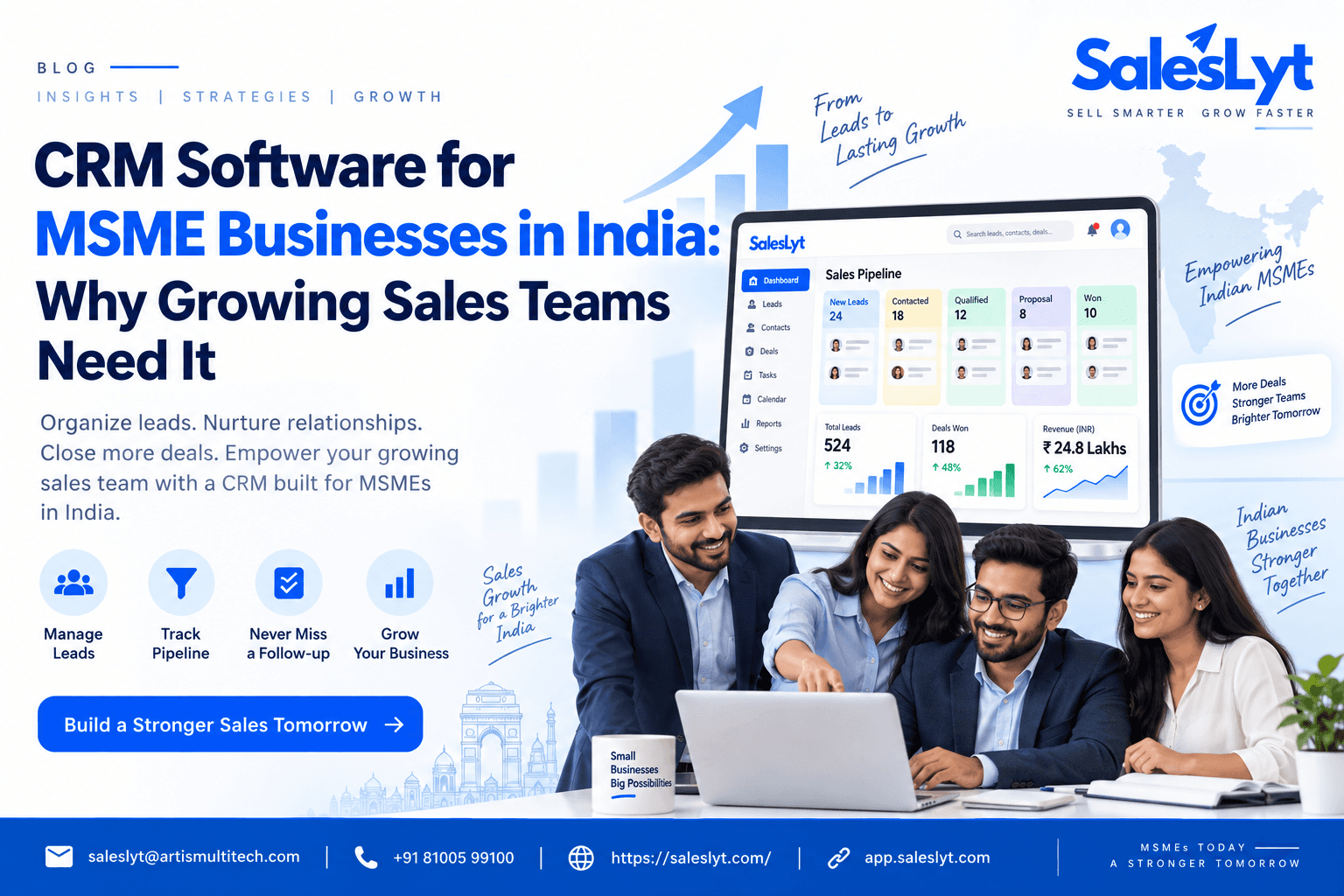
For Indian businesses looking for CRM software for MSME businesses in India, this broader sales-management approach can be particularly useful because many MSMEs need to track more than contacts.
They may need to know:
Which enquiries need attention?
Which salesperson owns each opportunity?
Which follow-ups are overdue?
Which deals are moving slowly?
How are field sales activities progressing?
Which quotations and payments are pending?
SalesLyt is built around these everyday sales activities.
Where SalesLyt stands out
One of SalesLyt's strongest advantages is that its AI capabilities are connected to actual sales activity.
AI-powered insights can help teams understand opportunities and make more informed decisions, while AI performance scoring can evaluate sales visits, calls and leads.
For businesses learning how to use AI in sales process workflows, this is important. AI should support salespeople rather than become another complicated tool they have to manage separately.
Best suited for: Indian MSMEs, B2B businesses, growing sales teams, field-sales organizations and companies looking for a CRM connected to the wider sales lifecycle.
2. HubSpot CRM
HubSpot is one of the better-known CRM platforms for companies that want sales, marketing and customer-management capabilities within a broader ecosystem.
Its AI capabilities are increasingly integrated across its platform, making it relevant for businesses that want sales and marketing automation together.
HubSpot can be particularly attractive to businesses already relying heavily on inbound marketing, website forms, email campaigns and content marketing.
However, small businesses should compare what they actually need before choosing a large ecosystem.
A CRM that looks attractive because of its extensive feature list may still create unnecessary complexity if the sales team only needs structured lead, deal and follow-up management.
Best suited for: Businesses that want CRM combined with a strong marketing ecosystem.
3. Zoho CRM
Zoho CRM is a familiar name among Indian small businesses and MSMEs.
Its AI assistant, Zia, supports areas including data management, productivity, customer experience, analytics, intelligent alerts and customer engagement.
Zoho also benefits from being part of a much larger business-software ecosystem.
That can be valuable for companies already using other Zoho applications.
However, businesses searching for a Zoho CRM alternative should compare more than price. Consider usability, onboarding requirements, sales workflow, AI capabilities, follow-up management and how easily employees can adopt the system.
Best suited for: Businesses already using the Zoho ecosystem or wanting a broad range of connected business applications.
4. Salesforce Sales Cloud
Salesforce remains one of the most established CRM platforms for sophisticated sales organizations.
It offers extensive customization, automation, reporting and AI capabilities and can support complex sales processes across large organizations.
The challenge for smaller businesses is determining whether that level of flexibility is actually necessary.
Companies looking for a Salesforce alternative are often not saying Salesforce lacks features. They may simply want something easier to implement, easier for a smaller team to manage or better aligned with their operational scale.
Small businesses should therefore compare total complexity, training requirements and implementation effort alongside features.
Best suited for: Larger or rapidly scaling organizations with complex CRM requirements.
5. Freshsales
Freshsales, part of the Freshworks ecosystem, is another CRM option frequently considered by growing businesses.
Its CRM approach combines contact management, pipeline management, communication and sales automation, while Freshworks has increasingly incorporated AI throughout its products.
For small businesses, the main consideration is whether Freshsales' workflow and ecosystem fit the way their salespeople already work.
Best suited for: Growing businesses wanting CRM functionality within the Freshworks ecosystem.
6. Pipedrive
Pipedrive has built much of its reputation around visual pipeline management and a sales-focused interface.
Its AI CRM capabilities include tools designed to help users prioritize deals, identify potential next actions and generate sales emails.
This makes it particularly relevant for teams whose biggest requirement is managing opportunities through a clear pipeline.
When considering Pipedrive, businesses should compare whether they need mainly pipeline management or a wider operational system covering activities such as team performance, field sales, quotations and payments.
Best suited for: Sales teams that place strong emphasis on visual deal and pipeline management.
7. monday CRM
monday CRM combines CRM functionality with the flexible workflow approach associated with the broader monday.com platform.
Its current capabilities include AI-supported lead sourcing, lead qualification, meeting notes, deal insights, automated workflows, quotes and invoices.
This can make it attractive to companies that want highly configurable workflows.
The trade-off is that flexibility sometimes requires teams to spend more time designing how they want the CRM to operate.
Best suited for: Businesses wanting highly customizable sales workflows and broader work-management capabilities.
8. Insightly
Insightly positions itself as a CRM for growing companies and has added AI functionality through features such as Copilot, AI email replies and AI email summaries.
Its AI tools can assist with record management, communication, task creation and sales insights.
This makes Insightly an option for businesses that want automation while maintaining a relatively traditional CRM structure.
Best suited for: Growing organizations wanting CRM, workflow automation and AI communication assistance.
9. Capsule CRM
Capsule focuses on simplicity, contact management and pipeline organization.
Its AI features include contact summaries, email assistance and an AI sales pipeline generator.
For a very small team, simplicity can be an advantage.
Not every company needs an enterprise-scale platform with hundreds of configurable options. Sometimes successful CRM adoption depends on whether salespeople are willing to use the system every day.
Best suited for: Small teams wanting a straightforward CRM with practical AI assistance.
10. Copper CRM
Copper is particularly associated with businesses that work heavily within Google Workspace.
Its CRM includes pipelines, workflow automation, reports, tasks and AI-powered alerts designed to highlight activity within deals.
Businesses relying heavily on Gmail, Google Calendar and related tools may find that integration approach appealing.
Best suited for: Service-oriented businesses and teams whose workflow revolves around Google Workspace.
What Should You Compare Before Choosing an AI CRM?
Looking at a list of the Top 10 AI CRM software for small businesses is useful, but it should only be the beginning of the decision process.
The following factors matter more than the number of features displayed on a pricing page.
1. Does the CRM fit your sales process?
Before buying software, document your current B2B sales process.
For example:
Lead → Qualification → Meeting → Follow-Up → Quotation → Negotiation → Won
Then check whether the CRM can support those stages without making your process unnecessarily complicated.
A CRM should fit the business reasonably well rather than forcing the business to completely redesign its way of selling.
2. Does AI solve a real problem?
Businesses exploring how to use AI in sales process management should start with business problems, not AI features.
Useful applications may include:
Lead prioritization
Sales predictions
Follow-up recommendations
Performance analysis
Email assistance
Activity summaries
Deal-risk identification
SalesLyt, for example, uses AI-powered insights, predictions and performance scoring alongside CRM and pipeline information.
That makes AI part of everyday sales management rather than a disconnected feature.
3. Will your sales team actually use it?
This is one of the most overlooked questions.
A powerful CRM has little value when salespeople avoid updating it.
When evaluating the best CRM for MSME in India, look at usability alongside functionality.
Your salesperson should be able to quickly understand:
What should I do today?
Who should I follow up with?
Which deals need attention?
What is happening with my customers?
If getting these answers requires navigating through many complicated screens, adoption may become difficult.
4. Can it help you improve your sales process?
Businesses researching how to improve sales process performance often focus first on generating more leads.
But improving conversion from existing opportunities can be equally important.
A useful CRM should help identify where opportunities are being delayed, where follow-ups are being missed and where managers need to intervene.
Better visibility creates better conversations between salespeople and managers.
5. What happens after a lead becomes a deal?
Small-business sales rarely finish at the pipeline stage.
A company may still have to create a quotation, send an invoice and track payment.
This is one area where SalesLyt's broader sales-management approach becomes relevant. Its platform includes quotation, invoice and payment tracking alongside CRM functionality.
For MSMEs, reducing the number of disconnected tools involved in the sales lifecycle can simplify daily operations.
Why SalesLyt Deserves a Close Look for Indian MSMEs
There is no single CRM that is automatically best for every business.
HubSpot may suit marketing-focused organizations. Zoho may appeal to businesses already within its ecosystem. Salesforce can support highly complex enterprise environments. Pipedrive is strong around visual pipelines.
But Indian MSMEs often have a different requirement.
They need enough functionality to professionalize their sales operations without making sales management unnecessarily complicated.
SalesLyt brings together lead management, customer management, pipeline visibility, automated follow-ups, AI insights, performance scoring, geo-tagging, analytics, quotations, invoices and payment tracking in one sales platform.
That combination makes SalesLyt particularly worth evaluating if your business has a growing B2B or field-sales team.
Conclusion
Choosing from the Top 10 AI CRM software for small businesses should not come down to which platform has the longest feature list.
The right choice depends on your team size, sales process, customer journey, reporting needs, budget and the level of complexity your business can realistically manage.
If your goal is to organize leads, reduce missed follow-ups, improve pipeline visibility and use AI to make smarter sales decisions, focus on the system that supports those activities naturally.
For Indian MSMEs and growing B2B sales teams, SalesLyt provides an especially relevant combination of CRM, AI-powered sales insights, automation, field-sales visibility, pipeline management and wider sales lifecycle management.
The important question is not simply:
“Which CRM has AI?”
It is:
“Which CRM will actually help our sales team work better every day?”
For businesses looking for CRM software for MSME businesses in India, SalesLyt is built around exactly that challenge—helping teams stay organized, follow up consistently, understand their pipeline and turn more sales activity into measurable growth.
Explore SalesLyt and see how an AI-powered CRM can help your sales team sell smarter, manage opportunities better and grow with greater visibility.

Conclusion
Choosing from the Top 10 AI CRM software for small businesses should not be based only on which platform offers the most features.
The right CRM should match the way your team works, make follow-ups easier, improve pipeline visibility, reduce repetitive tasks, and help managers understand what is happening across the sales process.
Businesses should also look carefully at usability, automation, AI capabilities, reporting, pricing, customer support, and how easily the CRM can grow with the team.
For companies learning how to use AI in sales process management, the goal should be practical improvement rather than simply adding more technology. AI should help teams prioritize opportunities, identify important activities, understand performance, and make better sales decisions.
For Indian MSMEs and growing B2B sales teams, SalesLyt is especially worth considering. It brings together lead management, pipeline tracking, automated follow-ups, AI-powered insights, performance scoring, sales analytics, quotations, invoices, payment tracking, and sales management in one platform.
If you are looking for the best CRM for MSME in India, focus on the CRM that your team can actually use every day and that helps you improve your sales process as the business grows.
SalesLyt is built to help growing sales teams stay organized, manage opportunities better, use AI more effectively, and turn sales activity into measurable growth.