For many MSMEs, closing a deal does not happen in a few days.
A customer may first ask for basic information, then request a product discussion, compare quotations, speak with management, negotiate commercial terms, and finally make a decision several weeks later.
In manufacturing, industrial supply, distribution, consulting, and other B2B businesses, a sales cycle can easily stretch to 30, 60, or even 90 days.
The problem is not always the length of the cycle.
The real challenge is keeping every opportunity organized for that entire period.
That is why choosing the best CRM for MSME in India becomes important for businesses where sales depend on repeated follow-ups, multiple conversations, quotations, and internal approvals.
A CRM should not simply store customer names and phone numbers. It should help your team understand what happened previously, what needs attention now, and what should happen next.
Why Long B2B Sales Cycles Are Difficult for MSMEs
Long sales cycles create more chances for information to get lost.
Imagine this situation.
A salesperson speaks with a potential customer on Monday. The customer asks for a quotation. The quotation is sent on Wednesday. A week later, the customer says the proposal is under management review.
The salesperson makes a note to follow up after ten days.
Meanwhile, ten other enquiries arrive.
If that follow-up is stored only in memory, WhatsApp, a notebook, or an Excel sheet, it can easily be forgotten.
Multiply this across an entire sales team and the business may have dozens of opportunities that are technically active but not being managed properly.
This is where a structured B2B sales process becomes valuable.
Instead of depending on individual memory, every opportunity should move through defined stages with clear actions and ownership.
What Should the Best CRM for MSME in India Actually Do?
There is no value in selecting a CRM simply because it has the longest feature list.
For an MSME managing long sales cycles, the system needs to solve practical everyday problems.
The right CRM should help the team answer questions such as:
Which customers need a follow-up today?
Which opportunities have not moved for two weeks?
Which quotations are waiting for a response?
Which deals are close to a decision?
Who is responsible for each customer?
What happened during the last conversation?
Which opportunities deserve immediate attention?
Which deals are repeatedly getting delayed?
If a CRM makes these answers easy to find, it can improve both sales execution and management visibility.
1. A Clear Sales Pipeline
A long sales cycle becomes much easier to manage when every deal has a clear stage.
For example:
New Lead → Qualified → Requirement Discussion → Quotation Sent → Negotiation → Decision Pending → Won/Lost
The exact stages may vary depending on the business.
A manufacturing company may include stages for technical discussion, sample approval, or commercial evaluation.
An industrial supplier may use:
Enquiry → Quotation → Follow-Up → Negotiation → Purchase Order
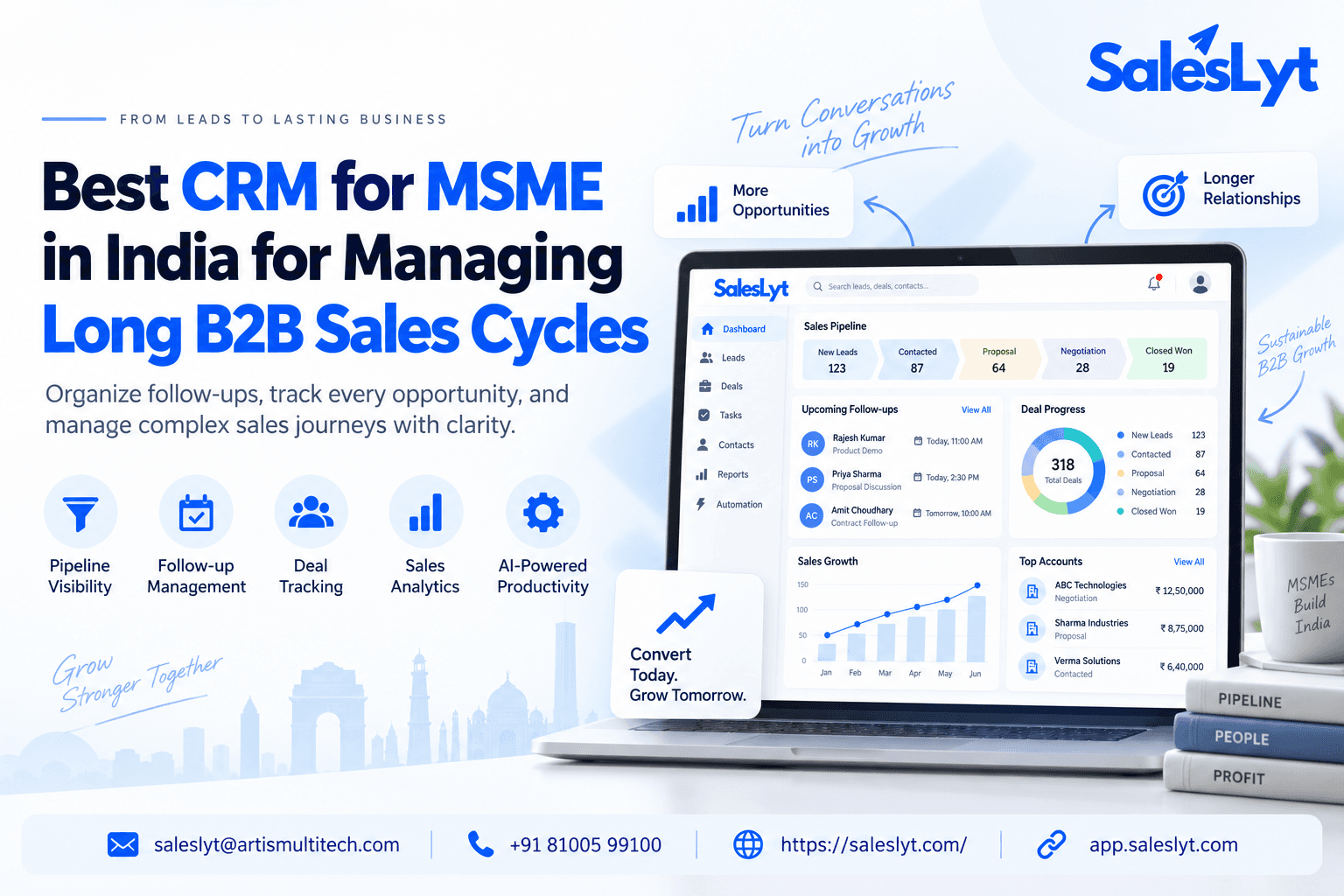
A structured pipeline gives the sales team a common way to manage opportunities.
Managers can also see where deals are getting stuck without asking every salesperson for updates.
SalesLyt currently highlights sales pipeline management as one of its core CRM capabilities, along with lead tracking and automated follow-ups.
2. Strong Follow-Up Management
One of the biggest problems in long B2B cycles is simple:
The customer is interested, but the salesperson follows up too late.
When a customer says:
“Call me after two weeks,”
that should immediately become a scheduled next action.
A good CRM should help your team keep those actions visible rather than relying on memory.
This is especially important when one salesperson is managing 30, 50, or even more opportunities at the same time.
Knowing how to manage customer deals is often less about selling harder and more about maintaining consistent communication.
Every active opportunity should ideally have:
Last activity: What happened recently
Next action: What needs to happen
Next date: When it should happen
Owner: Who is responsible
That simple structure prevents many good opportunities from quietly going cold.
3. Complete Customer and Deal History
A long sales cycle naturally creates a long history.
Over several weeks, the customer may discuss:
Product requirements
Pricing
Delivery schedules
Payment terms
Technical specifications
Quantities
Discounts
Implementation questions
Internal approvals
If the information is scattered across emails, calls, messages, notebooks, and spreadsheets, every new conversation becomes harder.
A CRM should provide a central view of the relationship.
When the salesperson opens an opportunity, they should quickly understand what has already happened.
This is one of the most practical reasons growing companies start looking for CRM software for MSME businesses in India.
The value is not simply digital storage.
The value is continuity.
4. Quotations Should Be Connected to the Deal
For many MSMEs, quotations play a major role in the sales cycle.
Yet businesses often manage their CRM and quotations separately.
The salesperson updates the lead in one system, prepares a quotation somewhere else, emails the customer, and then manually records the status in a spreadsheet.
This creates extra work and increases the chance of missing information.
For long sales cycles, the team should be able to quickly see:
When the quotation was created
Which version was sent
What amount was quoted
Whether the customer requested changes
When the next commercial follow-up is due
SalesLyt currently combines CRM activities with quotation, invoice, and payment-management capabilities, allowing more of the lead-to-revenue process to stay connected.
5. Identify Stalled Deals Early
Not every open opportunity is an active opportunity.
Suppose your pipeline contains 80 deals.
Twenty may have had meaningful customer activity this week.
Another 25 may be waiting for internal customer approval.
The remaining deals may not have moved for several weeks.
If all 80 appear identical in the pipeline, the sales forecast becomes misleading.
A CRM should make it easier to identify deals that need attention.
Possible warning signs include:
No recent activity
Expected closing date has passed
Multiple unanswered follow-ups
Opportunity stuck in one stage
No next action scheduled
Understanding this is an important part of learning how to improve sales process management.
Sometimes the problem is not generating more leads.
It is recognizing that existing opportunities have stopped moving.
6. Prioritize the Right Opportunities
Not every customer deserves the same amount of time today.
A salesperson may have 40 active deals, but perhaps only five require immediate action.
CRM systems can help teams prioritize based on information such as:
Sales stage
Deal value
Customer engagement
Recent activity
Expected closing date
Follow-up status
Lead quality
This becomes particularly useful when thinking about how to use AI in sales process management.
AI-supported CRM tools can help identify patterns, surface useful insights, and support prioritization.
SalesLyt currently highlights AI-powered insights and predictions, AI performance scoring, and sales analytics among its features.
The purpose of AI should not be to replace salesperson judgment.
Instead, it should make important information easier to notice.
7. Give Managers Better Visibility
One common MSME sales-management problem sounds like this:
“Please tell me which deals will close this month.”
The manager then contacts each salesperson individually.
One employee checks WhatsApp.
Another opens an Excel sheet.
Someone else tries to remember what happened during yesterday's customer visit.
That process does not scale.
With a structured CRM, managers can review pipeline activity from one place.
They can look at:
Open opportunities
Deal stages
Follow-ups
Sales activities
Expected closures
Team performance
Stalled opportunities
SalesLyt's current platform also highlights dashboards, analytics, manager review, task monitoring, performance tracking, and customizable dashboards.
For an MSME, this can reduce the need for constant manual status reporting.
8. The CRM Must Fit How the Team Actually Sells
The best CRM for MSME in India is not necessarily the most complex CRM.
It is the system that fits the company's actual sales workflow.
For example, a B2B industrial supplier may need:
Lead → Call → Customer Visit → Follow-Up → Quotation → Negotiation → Order
A service company may have:
Lead → Discovery Call → Proposal → Follow-Up → Negotiation → Agreement
The CRM should support the real sales process instead of forcing the team into an unnecessarily complicated structure.
SalesLyt positions itself around growing B2B teams and currently includes lead and customer management, follow-ups, pipeline tracking, geo-tagging, AI insights, sales analytics, quotations, invoices, and payment tracking.
How SalesLyt Can Help With Long B2B Sales Cycles
SalesLyt is an AI-powered CRM and sales-management platform designed for small businesses, startups, agencies, and growing B2B sales teams.
For businesses managing longer sales cycles, its current feature set includes:
Lead and customer management to keep opportunities organized.
Automated follow-ups to reduce missed customer interactions.
Sales pipeline management to show where each deal currently stands.
AI-powered insights and predictions to support sales decisions.
AI performance scoring for leads, calls, and sales visits.
Analytics and dashboards to give managers better visibility.
Geo-tagging for businesses with field-sales activities.
Quotation management to keep commercial activity closer to the deal.
Invoice and payment tracking to extend visibility beyond the point where the deal is won.
For an MSME, the advantage of a connected system is that the sales journey becomes easier to follow:
Lead → Follow-Up → Opportunity → Quotation → Customer → Invoice → Payment
Instead of maintaining a separate spreadsheet or tool for every stage, the team can work through a more organized sales process.
A Simple Way to Evaluate a CRM Before Choosing
Before selecting any CRM, take five real opportunities from your existing pipeline.
Then ask your team whether the CRM makes it easy to see:
What happened last?
What happens next?
Who owns the opportunity?
When is the next follow-up?
What stage is the deal currently in?
What quotation was sent?
How long has the deal been in the current stage?
If these answers are difficult to find, the system may add complexity without solving the real problem.
A CRM should make everyday sales management simpler.
Conclusion
Choosing the best CRM for MSME in India becomes especially important when your business deals with long B2B sales cycles.
When opportunities take 30–90 days to close, missed follow-ups, scattered customer information, outdated quotations, and unclear sales stages can quietly reduce conversions.
A structured B2B sales process gives every opportunity a clear journey. Learning how to manage customer deals helps your team maintain momentum. Understanding how to improve sales process visibility helps managers identify bottlenecks earlier. And knowing how to use AI in sales process management can help teams prioritize opportunities and make better use of available data.
The right CRM software for MSME businesses in India should bring these activities together without making sales work more complicated.
SalesLyt is designed around that connected approach, combining lead management, follow-ups, pipeline tracking, AI-powered insights, analytics, quotations, invoices, and payment tracking within a broader sales-management workflow.
For a growing MSME, the goal is not simply to have more leads in the pipeline.
It is to make sure the right deal never gets forgotten while the customer is still making a decision.
Conclusion
Selecting the best CRM for MSME in India becomes even more important when businesses handle long and complex B2B sales cycles. A well-structured CRM helps teams stay on top of follow-ups, track deal progress, improve visibility, and maintain consistency throughout the sales journey. When combined with a clear B2B sales process, better deal management, and the smart use of AI, the right CRM can help MSMEs improve productivity and close more opportunities with confidence.