A CRM should make selling easier.
But for many small B2B sales teams, the opposite can happen.
The team starts with a simple goal: keep leads organized, remember follow-ups, track opportunities, and understand what is happening in the sales pipeline. Over time, the CRM becomes filled with fields, workflows, dashboards, permissions, configurations, and features that the team rarely uses.
Instead of helping salespeople sell, the system starts demanding more administration.
This is one reason growing businesses begin searching for a Salesforce alternative that better matches the way a smaller sales team actually works.
For an MSME, manufacturer, distributor, industrial supplier, agency, or B2B service company, the objective is usually not to build the most sophisticated CRM environment possible. The objective is to create a sales system that the team will actually use every day.
Why CRM Complexity Becomes a Problem for Small Sales Teams
Powerful CRM platforms can support complicated sales organizations, large departments, multiple business units, and highly customized processes.
But a five-person sales team may have very different needs from a company with hundreds of sales representatives.
A small B2B team usually needs clear answers to questions such as:
Which leads need attention today?
Who is responsible for each opportunity?
Which customer needs a follow-up?
Which quotations are still open?
Which deals are moving forward?
Which opportunities have become inactive?
What should the salesperson do next?
How much business is currently in the pipeline?
When getting these answers requires multiple screens, reports, fields, or administrative steps, CRM complexity starts affecting productivity.
Salespeople may eventually return to familiar tools such as Excel, notebooks, personal reminders, or WhatsApp.
Once that happens, management loses visibility again.
The problem is not necessarily the CRM itself. The problem is often the mismatch between the complexity of the system and the actual requirements of the team.
A Salesforce Alternative Should Simplify the Sales Process
When evaluating a Salesforce alternative, small B2B companies should avoid comparing platforms only by the number of features they offer.
More features do not automatically create a better sales process.
The better question is:
What does our sales team genuinely need to manage every day?
For many growing businesses, the core workflow is straightforward:
Lead → Contact → Follow-up → Opportunity → Quotation → Negotiation → Order → Payment
A CRM should make this journey easy to understand.
This becomes particularly important when businesses are trying to learn how to improve sales process efficiency.
Instead of creating unnecessary steps, the CRM should remove friction from the process.
1. Keep Lead Management Simple
Lead management is one of the first areas where unnecessary complexity appears.
A salesperson should not need to complete a long form before saving a new enquiry.
Initially, businesses usually need only essential information such as:
Customer or company name
Contact person
Phone number
Email
Lead source
Requirement
Assigned salesperson
Current status
Next follow-up date
Additional information can be added as the opportunity develops.
Making every field compulsory from the beginning increases data-entry work and can reduce CRM adoption.
For businesses looking for CRM software for MSME businesses in India, ease of daily usage should therefore be one of the main evaluation criteria.
2. Build the CRM Around the Real B2B Sales Process
Your CRM should reflect how your business actually sells.
A typical B2B sales process may involve several conversations before an order is placed.
For example, a manufacturing or industrial sales journey might look like:
Enquiry → Requirement Discussion → Site Visit → Quotation → Follow-up → Negotiation → Purchase Order
A service company may follow:
Lead → Discovery Call → Proposal → Follow-up → Negotiation → Closed
Trying to force both companies into exactly the same process would create unnecessary complications.
The CRM should provide structure while still allowing the business to follow its natural sales cycle.
3. Make Follow-Ups Impossible to Ignore
In small B2B businesses, many opportunities are lost quietly.
The customer does not reject the quotation.
The salesperson simply forgets to follow up.
This problem becomes more serious when sales cycles last several weeks or months.
A useful CRM should clearly show:
Follow-ups due today
Overdue activities
Upcoming meetings
Opportunities waiting for action
The salesperson responsible
The next planned activity
This makes it easier to understand how to manage customer deals without constantly asking individual salespeople for updates.
A good CRM should reduce dependence on memory.
4. Reduce the Number of Tools Your Team Uses
Imagine a sales team operating like this:
Lead details are stored in Excel.
Customer conversations happen on WhatsApp.
Meeting notes are written in notebooks.
Quotations are stored on individual laptops.
Follow-ups are remembered through phone alarms.
Pipeline reviews happen through manually prepared spreadsheets.
Technically, the company has all the information.
Practically, nobody has the complete picture.
One purpose of CRM software should be to bring important sales information into a more organized system.
When considering a Salesforce alternative or even a Zoho CRM alternative, businesses should therefore ask whether the platform can simplify the existing workflow rather than introduce another isolated tool.
5. Focus on Actionable Dashboards
Small sales teams rarely need dozens of reports.
They need a few useful numbers.
A sales manager may want to know:
Total active leads
Follow-ups due
Open opportunities
Pipeline value
Deals by stage
Quotation status
Sales activities completed
Opportunities that have not moved recently
The purpose of a dashboard is not to display as much information as possible.
It should help the manager identify where attention is required.
A simple dashboard that is reviewed every morning may be more valuable than a highly sophisticated reporting system that nobody opens.
6. Automate Repetitive Work, Not the Relationship
Automation can reduce CRM complexity when it is used carefully.
For example, businesses can automate:
Follow-up reminders
Task creation
Lead assignment
Activity notifications
Email actions
Sales workflow steps
Management alerts
But automation should support the salesperson rather than create complicated workflows that nobody understands.
This is also where businesses are exploring how to use AI in sales process management.
AI can help teams analyse sales information, identify patterns, prioritize opportunities, and surface useful recommendations. However, the objective should remain simple: help the salesperson decide what deserves attention next.
Technology should support decision-making, not make the workflow harder to understand.
7. Choose a CRM Your Team Will Actually Use
CRM adoption is often underestimated.
A business can purchase a powerful platform, configure dozens of features, and create several dashboards.
None of that matters if salespeople do not update the system.
Before selecting a CRM, ask a salesperson to perform basic activities:
Add a lead.
Schedule a follow-up.
Update a deal.
Record a customer visit.
Check today's tasks.
Find an old conversation or activity.
If these everyday activities feel unnecessarily difficult, the CRM may become harder to maintain as the team grows.
The best CRM for MSME in India is therefore not automatically the platform with the longest feature list.
It is the platform that matches the company's sales process and is simple enough for consistent daily use.
What Small B2B Teams Should Look for in a Salesforce Alternative
When comparing CRM platforms, focus on practical requirements.
Look for a system that can help your team manage:
Lead visibility
Every active lead should have a clear owner, status, and next action.
Follow-up management
Salespeople should easily understand who needs to be contacted and when.
Pipeline tracking
Managers should know where opportunities are sitting and which deals require attention.
Customer history
Important interactions should remain available to the team rather than staying on individual devices.
Team accountability
It should be clear who owns each lead, task, follow-up, or opportunity.
Sales automation
Routine activities should be automated where doing so genuinely saves time.
Reporting
Managers should be able to understand sales performance without manually combining several spreadsheets.
Scalability
The CRM should work for the current team while providing room for the business to grow.
Where SalesLyt Fits for Growing B2B Teams
SalesLyt is designed around the idea that growing sales teams need structure without unnecessary complexity.
It brings lead management, follow-ups, sales pipelines, customer relationships, team activities, AI-powered insights, automation, and sales visibility into one sales management environment.
For businesses where the sales journey continues beyond the initial opportunity, SalesLyt also supports processes around quotations, invoices, and payment tracking.
This can be particularly useful for manufacturers, industrial suppliers, distributors, and other B2B companies where a customer journey may include enquiries, visits, quotations, negotiations, orders, and payment follow-ups.
Instead of making salespeople spend their day managing a CRM, the objective is to help the CRM support the salesperson.
CRM Complexity Usually Grows Slowly
CRM complexity rarely appears overnight.
A company starts with a few fields.
Then another field is added.
Then another workflow.
Then a new dashboard.
Then more stages.
Then additional approvals.
Eventually, even a simple sales update may require several actions.
That is why businesses should periodically review their CRM and ask:
Does this feature help us sell, manage customers, or make better decisions?
If the answer is no, it may not belong in the everyday sales process.
Simplification is not about removing useful capabilities.
It is about removing unnecessary friction.
Before Switching CRM Platforms
If your business is already using another CRM, do not migrate simply because a different platform appears easier.
First identify where the existing complexity comes from.
Review:
Fields your team never uses
Reports nobody checks
Duplicate information
Unnecessary pipeline stages
Workflows that create extra work
Manual tasks that could be automated
Information stored outside the CRM
Areas salespeople regularly complain about
Once these problems are clear, you can evaluate whether changing the current configuration is enough or whether moving to a different Salesforce alternative makes more sense.
This approach also makes migration easier because the new system can be built around a cleaner sales process instead of copying old complexity into a new CRM.
Final Thoughts
A small B2B sales team does not need complexity to become organized.
It needs clarity.
Every salesperson should know which leads they own, which customers require follow-up, which deals are moving, which opportunities are stuck, and what action needs to happen next.
Every manager should be able to see the same information without chasing the team for updates.
That is what a useful CRM should provide.
When searching for a Salesforce alternative, do not simply compare the number of features offered by each platform. Look at how easily the CRM fits into your real sales process.
The right system should reduce administrative work, improve visibility, make follow-ups easier, and help the team spend more time selling.
For growing Indian B2B businesses looking for a simpler way to manage leads, opportunities, follow-ups, sales activities, and customer relationships, SalesLyt provides an AI-powered sales CRM designed around structured and practical sales management.
Explore SalesLyt: https://saleslyt.com/
Conclusion
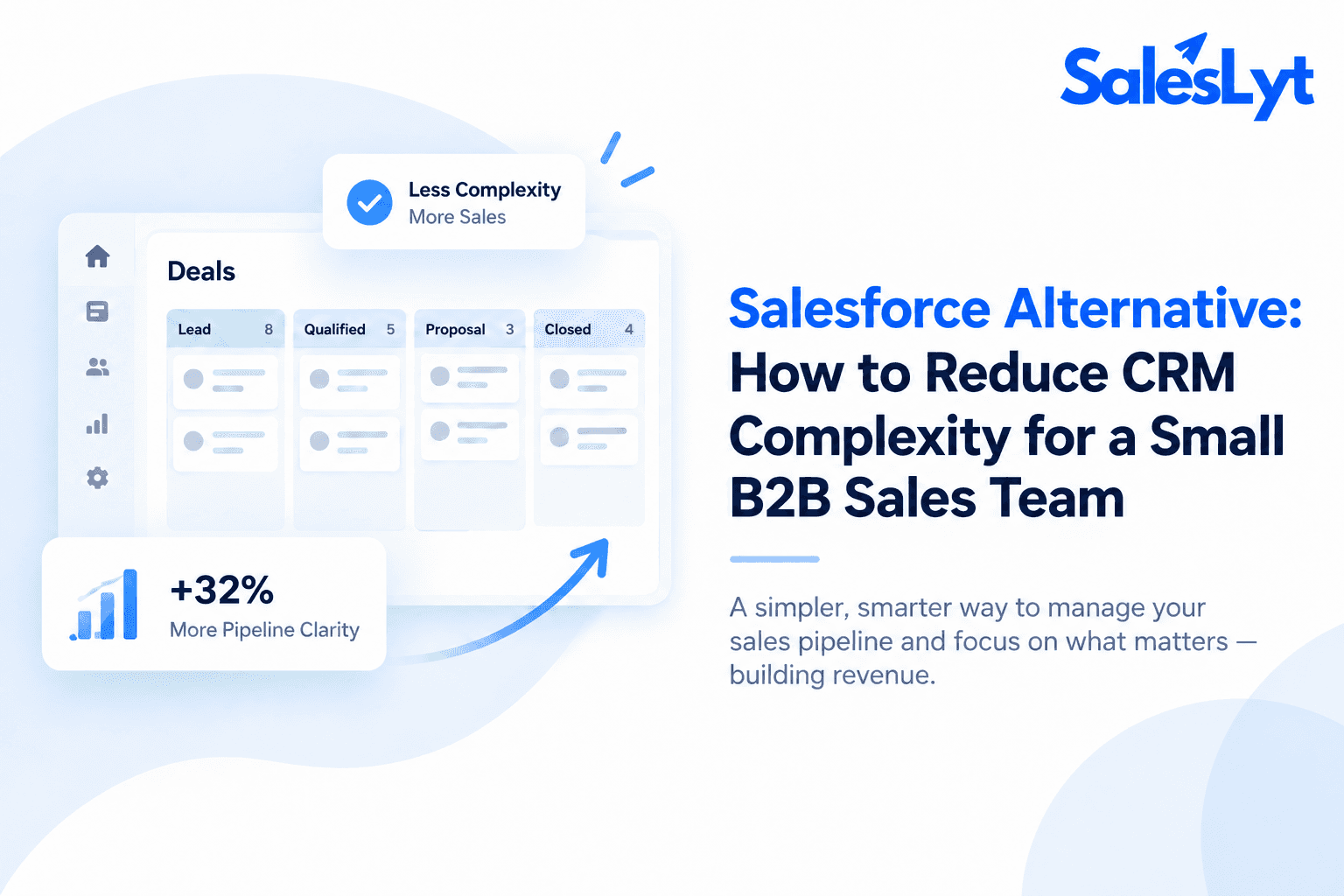
For a small B2B sales team, a CRM should simplify work, not make it more complicated. If your team is spending too much time on data entry, switching between tools, or managing unnecessary workflows, it may be time to consider a better-fit Salesforce alternative.
The right CRM should help your business organize leads, track follow-ups, manage opportunities, and improve sales visibility without overwhelming the team. For growing MSMEs and B2B companies, SalesLyt offers a practical and structured way to manage the sales process with less complexity and more focus on closing deals.