Growing a business often creates a good problem: more leads, more customers, more conversations, and more opportunities.
But growth also makes sales harder to manage.
A spreadsheet that worked perfectly with 20 prospects may become difficult to maintain when your team is handling hundreds. Follow-ups get missed, customer information ends up in different places, and managers spend more time asking for updates than actually improving sales performance.
At this point, the problem may not be your sales team. It may be the system they are using.
The right CRM software for businesses gives sales teams a structured way to manage prospects, conversations, follow-ups, opportunities, and performance. So, how do you know when your existing process is no longer enough?
Here are seven signs worth paying attention to.
1. Your Sales Team Is Still Managing Leads Manually
Spreadsheets are useful. WhatsApp is convenient. Email is essential. But using all three as your main sales management system can quickly become confusing.
Imagine a prospect calls your salesperson today. The requirement is written in a notebook. A quotation is sent through email tomorrow, and the next follow-up date is saved on someone's phone.
What happens if that salesperson forgets?
This is one of the clearest signs that your business needs lead management software.
A centralized system helps your team maintain a proper record of leads and their activities. Good sales lead management software also makes it easier to understand who owns each lead, what happened during the previous interaction, and what should happen next.
For smaller teams, lead management software for small business can be especially valuable because employees often manage several responsibilities at the same time.
2. Follow-Ups Are Regularly Being Missed
Many sales opportunities are not lost because customers reject the offer. They are lost because the conversation simply stops.
A salesperson plans to call on Friday but gets busy with another client. Friday becomes Monday, Monday becomes Wednesday, and eventually the prospect starts speaking with another supplier.
If this happens regularly, reminders alone may not solve the problem.
An easy CRM for small business should help salespeople organize upcoming activities and see which prospects require attention. Instead of trying to remember dozens of follow-up dates, representatives can work from a clear list of actions.
The goal is simple: make following up part of the process rather than something dependent on memory.
3. Nobody Has a Clear View of the Sales Pipeline
Ask your sales manager:
“How much business is currently in the pipeline?”
If the answer requires calling every salesperson, checking multiple spreadsheets, and combining several reports, you probably have a visibility problem.
Effective sales pipeline management gives businesses a clearer picture of opportunities at different stages.
For example, managers should be able to understand which deals are new, which have reached the proposal stage, which are under negotiation, and which have stalled.
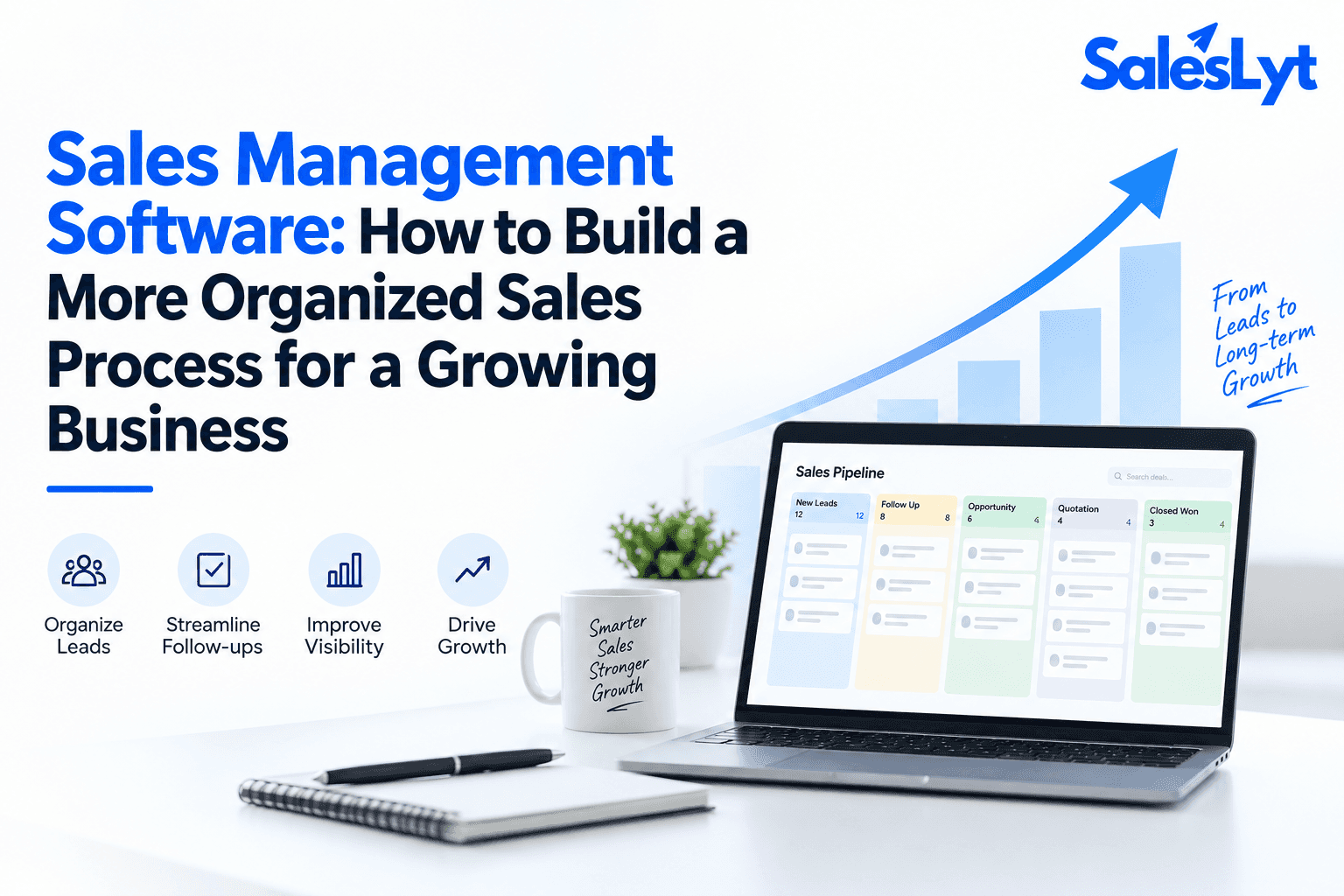
A visual sales pipeline tool makes those stages easier to understand, while a sales pipeline tracker can help teams monitor how individual opportunities move through the process.
This visibility is not just useful for managers. Salespeople also benefit because they can quickly identify the opportunities that need their attention.
4. Customer Information Is Spread Across Different Places
Where does your customer information live?
If the answer is “everywhere,” that is another warning sign.
A growing business might have contact details in Excel, call notes on personal phones, quotations in email, follow-up dates on calendars, and payment information somewhere else.
The problem becomes obvious when someone needs the complete history of a customer.
They cannot find it.
Good CRM software for businesses brings important relationship information into a more organized environment. This gives salespeople context before contacting a prospect and reduces the risk of information disappearing when responsibilities change.
It also makes teamwork easier. Customers should not have to repeat the same information every time they speak to a different person in your company.
5. Managers Cannot Clearly Measure Sales Performance
Revenue tells you what happened.
It does not always tell you why.
Suppose two sales representatives generate similar revenue. One may have a healthy pipeline and consistent follow-ups, while the other depends heavily on a few large opportunities. Looking only at final sales figures hides that difference.
This is where sales performance management software becomes useful.
Managers need visibility into activities, leads, follow-ups, pipeline movement, and results. With better information, they can identify where representatives are doing well and where additional support may be needed.
Modern AI sales management software can take this further by helping teams interpret sales activity and identify useful patterns.
For example, SalesLyt includes AI performance scoring for sales visits, customer calls, and leads, alongside KPI dashboards and productivity insights. This gives managers additional context when reviewing team performance.
6. Your Current System Cannot Keep Up with Growth
Many businesses wait until their sales process becomes chaotic before considering a CRM.
It is usually better to act earlier.
Perhaps you started with two salespeople and now have eight. Maybe you are entering new territories, adding services, or receiving significantly more enquiries than you did a year ago.
Growth increases the number of relationships your business needs to manage.
The best CRM for small business should therefore solve today's problems without immediately becoming unsuitable as the company grows.
The same principle applies to startups. When choosing the best CRM for startups, founders should consider how the system will work when they add more representatives, customers, opportunities, and sales activities.
A structured sales CRM for startups can establish consistent sales habits early. Rather than rebuilding the entire process later, teams can scale around a system they already understand.
Agencies face their own challenges. A sales CRM for agencies can help organize prospects, conversations, proposals, and follow-ups when multiple potential clients are moving through different stages at the same time.
The important question is not simply, “Do we need a CRM today?”
Ask, “Will our current process still work when our sales volume doubles?”
7. Your Sales Team Spends Too Much Time on Admin Work
Salespeople should spend their time selling, building relationships, understanding customer requirements, and moving opportunities forward.
But many teams spend a surprising amount of time updating spreadsheets, preparing status reports, searching for information, and manually reminding themselves about routine activities.
That administrative work adds up.
The right sales management software for small business can reduce repetitive work and create a more consistent workflow.
This is also where AI-powered sales software is becoming increasingly useful. Instead of treating CRM as a passive database, businesses can use AI-supported insights to understand sales activity and make better decisions.
SalesLyt, for example, combines AI-powered insights and prediction with lead tracking, automated follow-ups, smoother sales pipelines, dashboards, performance scoring, quotations, invoices, and payment tracking. The platform is designed to connect more of the sales lifecycle instead of leaving these activities scattered across separate tools.
What Should You Look for in Better CRM Software?
Recognizing the problem is only the first step. Choosing the right CRM matters just as much.
Avoid selecting software simply because it has hundreds of features.
Start with your actual sales process.
Can your team easily add and manage leads? Can salespeople schedule and track follow-ups? Can managers see the pipeline without asking for manual reports? Can you monitor performance? Can employees quickly understand what needs to happen next?
Ease of use matters because even powerful software provides little value if employees avoid using it.
Look for a system that gives your team enough structure without adding unnecessary complexity.
For a growing company, that could mean combining lead management, pipeline visibility, follow-ups, performance monitoring, automation, analytics, and AI-supported insights in one environment.
Better CRM Is About Better Sales Visibility
A CRM should not become another piece of software your employees are required to update.
It should make their work easier.
When information is organized, follow-ups are visible, and opportunities are clearly tracked, salespeople spend less time figuring out what happened and more time deciding what to do next.
Managers gain something equally important: visibility.
They can see where opportunities are getting stuck, understand team activity, identify potential problems earlier, and make decisions using actual sales information rather than assumptions.
If your business is experiencing several of the seven signs above, your current process may have reached its limit.
Moving to better CRM software for businesses can give your sales operation the structure it needs for the next stage of growth.
SalesLyt is built for startups, agencies, sales teams, and growing businesses that want to bring sales relationships and activities into a more connected workflow. Its capabilities include lead tracking, automated follow-ups, sales pipeline management, AI-powered insights, performance scoring, dashboards, quotations, invoices, and related sales lifecycle activities.
Because when your business grows, your sales process should grow with it—not become harder to control.